




X Close

Steve Bannon is no longer MAGA’s mastermind

Yesterday's man? Credit: Getty

Yesterday's man? Credit: Getty

October 30 2024 - 6:45pm

Steve Bannon emerged from federal prison this week looking ready to reclaim his role as MAGA’s chief strategist — but, at least for now, nobody seems to be hiring. Donald Trump’s former advisor, fresh from a four-month jail stint for defying a Congressional subpoena, launched straight into a marathon War Room podcast episode that pointed more to his current outsider status than any immediate return to power.

Bannon’s performance followed a familiar playbook: expansive claims about campaign strategy, warnings of election chaos, and positioning himself as the ultimate MAGA soothsayer. He spoke confidently about everything from Elon Musk’s importance to the coalition to Robert F. Kennedy Jr’s endorsement, as if he had been orchestrating moves from a command center rather than languishing in a prison cell. The reality is far more modest — Trump appears not to have meaningfully engaged with Bannon since 2020, when he notably remarked that “Steve is much better not being involved.” Prior to that, after booting Bannon from the White House in 2018, the then-President observed that “when [Steve] was fired, he not only lost his job: he lost his mind.”

The episode functioned as an audition tape of sorts, with Bannon thread-weaving among various MAGA factions. He hosted Trump-adjacent figures such as Charlie Kirk and Jack Posobiec while carefully avoiding direct claims about any current special relationship with the GOP candidate himself. His prison time has given him a fresh angle, and he’s now positioning himself as someone who can speak to working-class black and Latino males — whom he claims “despise Kamala Harris” — and help move the movement “beyond race”. Simultaneously he is laying groundwork for potential post-election chaos with talk of “preventing state nullification of results”.

The spectacle would be almost amusing if it weren’t so revealing about MAGA’s current power structure. Bannon, once Trump’s populist sherpa who helped shape a real-estate developer into a cultural warrior, now finds himself reduced to hosting a roadshow of secondary players. His immediate pivot to election conspiracy theories upon release suggests less a strategic genius and more a man desperately seeking relevance in a movement which has evolved beyond him.

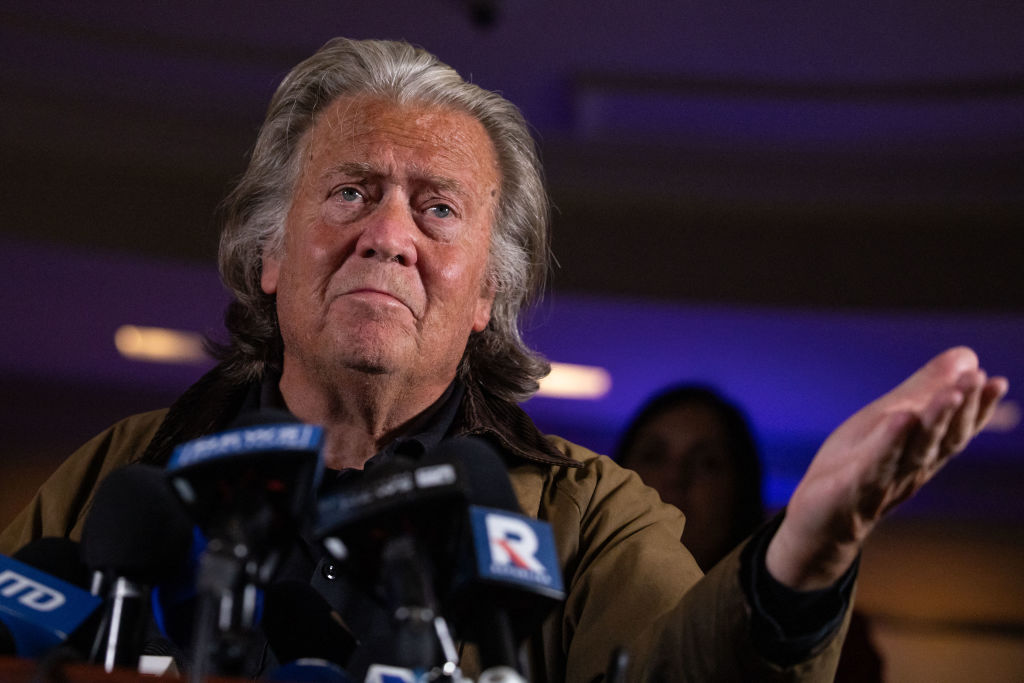
This all-hands-on-deck rhetorical approach also showed in Bannon’s post-release press conference, where he veered between claiming empowerment following incarceration and making juvenile taunts at Nancy Pelosi, whom he blames for his confinement. When not railing against a weaponized Justice Department, he kept returning to his newfound insights about minority voters, highlighting his interactions with Puerto Rican and Dominican inmates as if collecting DEI credits.

The timing of Bannon’s release, just a week before the election, might seem politically fortunate. But it mainly serves to highlight how far he’s fallen since his days as chief strategist in the West Wing. In 2017, his Time magazine cover as “The Great Manipulator” preceded his first fall from grace with an image-conscious Trump. Today, his responsibilities seem to consist primarily of ensuring his podcast can merit guest appearances from the actual MAGA insiders.

What makes this particularly striking is how it illuminates the broader evolution of Trump’s political ecosystem. The original architects of 2016’s populist revolution — Bannon, Roger Stone, Michael Flynn — have given way to newer, outsider characters such as Kennedy, Musk, J.D. Vance, Vivek Ramaswamy, and Tulsi Gabbard (Jordan Peterson this week dubbed the grouping “Trump’s X-Men”). Bannon’s attempt to rebrand himself as a tribune of minority voters feels stale compared to the more sophisticated online outreach efforts of Musk and Trump’s other campaign mouthpieces.

The Steve Bannon of 2024, though far from a spent force, is ultimately a testament to how quickly political fortunes can shift in the Trump universe. Four years ago, he could reliably present himself as the intellectual architect of a new America First populism. Now, despite his reputation, his chief influence comes from hosting and promoting brighter stars in the broader conservative media ecosystem on his podcast, witnessing the show rather than being at the heart of it. His prison release tour isn’t so much a comeback as a reminder that in politics, as in theater, timing is everything — and the time isn’t right for Bannon to resume a leading role.


Oliver Bateman is a historian and journalist based in Pittsburgh. He blogs, vlogs, and podcasts at his Substack, Oliver Bateman Does the Work

MoustacheClubUS

China is threatening America in the AI race

Reports sugget Zhipu AI  has released a new model that can rival leading US systems. Credit: Getty

Reports sugget Zhipu AI has released a new model that can rival leading US systems. Credit: Getty

July 1 2026 - 10:18am

China is trying to catch up with America on artificial intelligence. The Wall Street Journal has reported that Zhipu AI — one of China’s six “AI tiger” LLMs — has released a new model that can rival leading US systems, including Anthropic’s Mythos, in cybersecurity tasks such as pinpointing security bugs. While this marks a milestone in China’s drive to catch up with Western AI capabilities, strong performance on a single benchmark does not mean it has taken the lead. Chinese models still lag behind their Western counterparts in broader capabilities, such as autonomous operation. Skepticism is therefore warranted before resorting to hysterical conclusions, but complacency about the geopolitical implications of China’s AI advances would be an even greater mistake.

On the infrastructure side, Chinese AI is still constrained by access to advanced chips, with American labs way ahead in computing capacity as well as investment. Analysis from earlier this year suggests that Chinese models are likely to be at least a few months behind those in the US. But they are still continuing to make progress, or that the geopolitical importance of AI will be decided only by whose LLM has ventured deeper into the technological frontier. The practical applications of AI, countries’ to capture foreign markets, and the application of AI into the real economy will matter just as much.

Here, China may hold an advantage. As with its dominance across many critical supply chains, Beijing may not need to produce the most advanced AI systems — only those that are affordable and widely deployable. In doing so, it could consolidate global influence by supplying functional, low-cost AI at scale.

Beijing seems to be pursuing exactly that path, developing an AI “open-source” strategy that offers affordable, widely available AI models for companies and individuals to use and modify as they wish. The production of the DeepSeek AI model, which matched the performance of Silicon Valley tools such as ChatGPT at a fraction of the cost for users, created goodwill among Chinese models with developers.

The four most popular models on OpenRouter, an AI hardware platform for developers, are now all Chinese. The goal for China is not only to win the frontier-model race, but to make its systems the default layer of AI adoption across industries and global markets. For most economies, the choice is increasingly between an affordable tool they can deploy now and a more robust one that may be out of reach.

And while the countries adopting Chinese models may be exposed to political pressure and cyber threats from Beijing, safer and more capable alternatives matter little if they are unaffordable. American AI companies are already under pressure to monetize products whose operating costs are rising. If Chinese open-source models become the cheap default for startups, universities, governments and businesses across the developing world, then America’s AI lead will be eroded from below.

Perhaps more concerning for America in the long run is how AI can give Chinese manufacturing even more strength, through the ongoing integration of AI as a general-purpose technology. China’s new Five-Year Plan mentioned AI more than 50 times and includes an “AI+” action plan aimed at spreading AI across the economy.

Beijing has been pioneering automation of its critical infrastructure for years, with promising recent results in increasing warplane production capacity. In that regard, China’s open-model strategy and manufacturing dominance will reinforce each other. Cheap, adaptable models accelerate deployment across the real economy while those deployments generate real-world data and use cases that can feed back into further model improvement.

The United States should not dismiss the importance of its lead in the AI race. That lead worries Beijing, not least because a more automated Chinese economy would also become more vulnerable to AI-generated cyber threats. But nor should Washington assume that China cannot catch up with American capabilities over time.

This AI competition represents part of a broader struggle over tech supply chains and geopolitical influence. Decisions over whether to adopt US or Chinese models could produce a more fragmented global reality, with different regions relying on different cloud providers, chips and security structures. The result will likely be a global economy which is divided into competing spheres, rather than one which produces a single winner.


Miquel Vila is a political and geopolitical risk consultant focusing on industrial strategy, critical infrastructure and global supply chains.

miquelvilam