




X Close

Trump was preaching to the converted in Joe Rogan interview

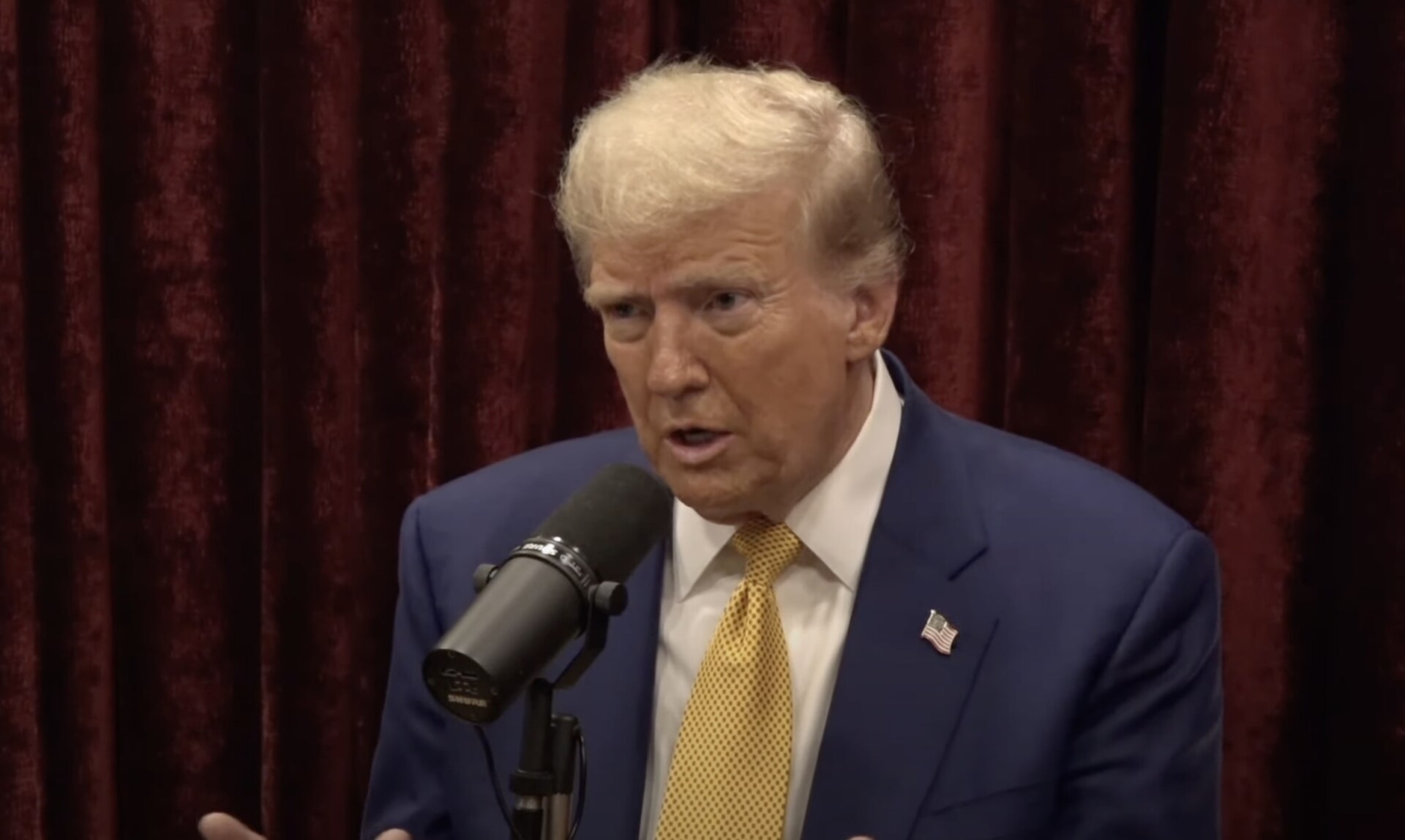
The former president had an easy ride on the show. Credit: JRE / YouTube

The former president had an easy ride on the show. Credit: JRE / YouTube

October 26 2024 - 5:00pm

With the US presidential election less than two weeks away, both campaigns are smacking of a certain desperation to win over as many voters as possible. For Democratic nominee Kamala Harris, this meant recruiting stars like Beyoncé and Bruce Springsteen to her rallies this week. For Donald Trump, it required finally appearing on the Joe Rogan Experience.

The pair covered everything from whale psychiatrists to bird carcasses during their three-hour conversation, but also went deep on Russian President Vladimir Putin, pesticides, golf, Hillary Clinton, ISIS, Kamala Harris, The View, UFC fights, immigration, and much more.

Rogan picked Trump’s brain on topics most journalists ignore, and the freewheeling format allowed for some constructive exchanges. Unlike the majority of people who get the opportunity to interview Trump — or any politician — Rogan wasn’t chasing easy soundbites, plaudits from the press corps, or gotcha moments. He approached areas of disagreement, like environmentalism, and the 2020 election, with genuine curiosity and a flattering premise that Trump’s position had been filtered through dishonest lenses.

The host started by asking Trump about a legendary clip from The View in which all of the hosts praised Trump not long before he ran for president. Trump said he really thinks about the time before and after his political career as “two different lives”. When he got into the Oval Office, Trump told Rogan, “I had two things, governing the country and survival”. “How did you know who to appoint?” Rogan asked. Trump replied, “I didn’t.” The former president continued: “The biggest mistake I made […] was that I picked people that I shouldn’t have picked.”

Trump, ever the opportunist, told the UFC commentator he should “do the same thing” as Elon Musk and offer an endorsement. “I’ve watched you for years, you’re not a Kamala person,” he quipped. Rogan laughed.

On Robert F. Kennedy Jr., Rogan asked if Trump was receiving pressure from his team to work with him.  Trump said yes. The former president also claimed Google CEO Sundar Pichai called him after last week’s McDonald’s trip and referred to it as “one of the biggest things we’ve ever had on Google”. Pressed by the comedian on why he didn’t unseal the remaining files about the assassination of John F. Kennedy, Trump said what’s left “addresses people that are still living”. But if he wins in November, he said: “I think it’s going to be just time to open it”.

Trump’s 2016 victory both presaged and boosted the podcast era, treating voters to what felt like a more authentic version of politics, where Trump’s reality television experience even sucked his highest minded opponents into the vortex.

On this podcast, Trump was the same as he always is. Whether on “60 Minutes” or Theo Vonn’s show or even those old-school debates, he never strays far from his schtick. Surely Rogan will be pilloried for failing to push Trump sufficiently on his continual refusal to accept the outcome of the 2020 election and what he thinks of Israel’s destructive war in Gaza. But Rogan doesn’t purport to be a journalist, and his goal is simply to have a good conversation.

Rogan once expressed trepidation over how his interviews with politicians could potentially change the course of the country. During a discussion with fellow podcast host Lex Fridman in 2022, Joe Rogan said he’d declined opportunities to have Trump on the show. “I don’t want to help him. I’m not interested in helping him,” he explained. This time round, it looks like Rogan may have done just that.

In a tied race, every little boost counts. Trump has already made his way around the podcast circuit, chatting with comedians Andrew Schulz and Theo Von. In this sense, appearing on the JRE may be appealing to a similar crowd and preaching to the already converted. But throughout these forays into podcast world, Trump has seemed extremely relaxed while Harris is still finding her tone. Even still, in a race too close to call, it’s a testament to our brave new world that success or failure may rest on talking a good game with Joe Rogan.

Emily Jashinsky is UnHerd‘s Washington correspondent.

emilyjashinsky

China is threatening America in the AI race

Reports sugget Zhipu AI  has released a new model that can rival leading US systems. Credit: Getty

Reports sugget Zhipu AI has released a new model that can rival leading US systems. Credit: Getty

July 1 2026 - 10:18am

China is trying to catch up with America on artificial intelligence. The Wall Street Journal has reported that Zhipu AI — one of China’s six “AI tiger” LLMs — has released a new model that can rival leading US systems, including Anthropic’s Mythos, in cybersecurity tasks such as pinpointing security bugs. While this marks a milestone in China’s drive to catch up with Western AI capabilities, strong performance on a single benchmark does not mean it has taken the lead. Chinese models still lag behind their Western counterparts in broader capabilities, such as autonomous operation. Skepticism is therefore warranted before resorting to hysterical conclusions, but complacency about the geopolitical implications of China’s AI advances would be an even greater mistake.

On the infrastructure side, Chinese AI is still constrained by access to advanced chips, with American labs way ahead in computing capacity as well as investment. Analysis from earlier this year suggests that Chinese models are likely to be at least a few months behind those in the US. But they are still continuing to make progress, or that the geopolitical importance of AI will be decided only by whose LLM has ventured deeper into the technological frontier. The practical applications of AI, countries’ to capture foreign markets, and the application of AI into the real economy will matter just as much.

Here, China may hold an advantage. As with its dominance across many critical supply chains, Beijing may not need to produce the most advanced AI systems — only those that are affordable and widely deployable. In doing so, it could consolidate global influence by supplying functional, low-cost AI at scale.

Beijing seems to be pursuing exactly that path, developing an AI “open-source” strategy that offers affordable, widely available AI models for companies and individuals to use and modify as they wish. The production of the DeepSeek AI model, which matched the performance of Silicon Valley tools such as ChatGPT at a fraction of the cost for users, created goodwill among Chinese models with developers.

The four most popular models on OpenRouter, an AI hardware platform for developers, are now all Chinese. The goal for China is not only to win the frontier-model race, but to make its systems the default layer of AI adoption across industries and global markets. For most economies, the choice is increasingly between an affordable tool they can deploy now and a more robust one that may be out of reach.

And while the countries adopting Chinese models may be exposed to political pressure and cyber threats from Beijing, safer and more capable alternatives matter little if they are unaffordable. American AI companies are already under pressure to monetize products whose operating costs are rising. If Chinese open-source models become the cheap default for startups, universities, governments and businesses across the developing world, then America’s AI lead will be eroded from below.

Perhaps more concerning for America in the long run is how AI can give Chinese manufacturing even more strength, through the ongoing integration of AI as a general-purpose technology. China’s new Five-Year Plan mentioned AI more than 50 times and includes an “AI+” action plan aimed at spreading AI across the economy.

Beijing has been pioneering automation of its critical infrastructure for years, with promising recent results in increasing warplane production capacity. In that regard, China’s open-model strategy and manufacturing dominance will reinforce each other. Cheap, adaptable models accelerate deployment across the real economy while those deployments generate real-world data and use cases that can feed back into further model improvement.

The United States should not dismiss the importance of its lead in the AI race. That lead worries Beijing, not least because a more automated Chinese economy would also become more vulnerable to AI-generated cyber threats. But nor should Washington assume that China cannot catch up with American capabilities over time.

This AI competition represents part of a broader struggle over tech supply chains and geopolitical influence. Decisions over whether to adopt US or Chinese models could produce a more fragmented global reality, with different regions relying on different cloud providers, chips and security structures. The result will likely be a global economy which is divided into competing spheres, rather than one which produces a single winner.


Miquel Vila is a political and geopolitical risk consultant focusing on industrial strategy, critical infrastructure and global supply chains.

miquelvilam