




X Close

Failed Senate revolt proves Trump’s hold over the GOP

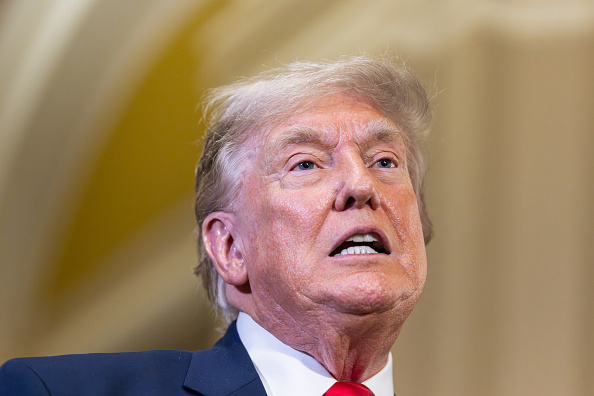
At a closed door lunch on Wednesday, Trump argued with senior  Senate Republicans. Credit: Getty

At a closed door lunch on Wednesday, Trump argued with senior Senate Republicans. Credit: Getty

June 26 2026 - 7:00pm

The latest Republican revolt against Donald Trump has already been over-interpreted. On paper, the scene looked dramatic enough: Trump at a closed-door Senate GOP lunch on Wednesday, shouting at Louisiana Senator Bill Cassidy over his vote for a war-powers resolution on Iran, reportedly calling him “a lunatic” and “a loser” while senators tried to de-escalate the situation. The episode had all the atmospherics of a party cracking under the strain of its own leader.

But the more plausible reading is simpler: it shows Trump’s enduring hold over the GOP.

Cassidy was one of four Republicans who backed the war-powers measure to limit Trump’s power in the Iran war, which narrowly passed 50-48 after two Republican absences. His explanation was almost painfully senatorial: the administration had not told Congress or the public enough about a war that was supposed to last four weeks and had instead stretched for four months. It was, in formal terms, a lofty constitutional argument. In political terms, it was a rebellion by a man already politically dead.

After all, Cassidy cannot be the face of a new anti-Trump GOP. Trump effectively ended his career by backing a successful GOP primary challenger in Louisiana, a defeat rooted largely in his vote to convict Trump after January 6. And so, if Cassidy is leading the charge, it has already failed — and his case is yet another warning for what happens to those who stray from the party line.

The aftermath proved it. Within hours of the blow-up, Cassidy was invited for a briefing with JD Vance and Steve Witkoff, thanked them publicly, and then helped deliver Trump a victory by voting with most Republicans to block a separate Iran war powers resolution. This is the whole GOP drama in miniature: confrontation, humiliation, private accommodation, public reunification.

The party has been here before, and the pattern is as old as Trump’s first term. Thomas Massie, Marjorie Taylor Greene, Jeff Flake, and others have all had their moments of spectacular disagreement with Trump. For a few days, journalists discover “cracks”. Then the base speaks, the incentives reassert themselves, and the party closes ranks. Trump’s authority does not require love or affection, only fear.

The Cassidy fight also came amid another Trumpian hostage-taking exercise: his refusal to sign a bipartisan housing bill until Republicans advanced his SAVE America Act, a voting bill that has no obvious path through the Senate. This is why congressional Republicans are trapped between a rock and a hard place. The rock is the unwaveringly pro-Trump primary electorate, which can end careers. The hard place is a general electorate increasingly exhausted by chaos, inflation, war, and theatrical grievance.

That is the real significance of the rift. Not that Trump has lost control, but that his control is becoming more politically expensive. Senate Republicans know the midterms are coming. They know affordability is a live and worsening issue. They know the Iran debacle is deeply unpopular. They know Trump’s obsessions can derail the basic work of governing. But knowing is not acting. The GOP remains a party capable of private irritation and occasional procedural dissent but not sustained institutional resistance. Its members can mutter, leak, agitate, threaten, and then return to the fold.

Trump’s grip is intact, even as the GOP’s broader electoral credibility is in the drain. The president’s grip is simply tightening around a party that may find, by November, that obedience and survival are no longer the same thing.


Michael Cuenco is Senior Editor at American Affairs.
1TrueCuencoism

China is threatening America in the AI race

Reports sugget Zhipu AI  has released a new model that can rival leading US systems. Credit: Getty

Reports sugget Zhipu AI has released a new model that can rival leading US systems. Credit: Getty

July 1 2026 - 10:18am

China is trying to catch up with America on artificial intelligence. The Wall Street Journal has reported that Zhipu AI — one of China’s six “AI tiger” LLMs — has released a new model that can rival leading US systems, including Anthropic’s Mythos, in cybersecurity tasks such as pinpointing security bugs. While this marks a milestone in China’s drive to catch up with Western AI capabilities, strong performance on a single benchmark does not mean it has taken the lead. Chinese models still lag behind their Western counterparts in broader capabilities, such as autonomous operation. Skepticism is therefore warranted before resorting to hysterical conclusions, but complacency about the geopolitical implications of China’s AI advances would be an even greater mistake.

On the infrastructure side, Chinese AI is still constrained by access to advanced chips, with American labs way ahead in computing capacity as well as investment. Analysis from earlier this year suggests that Chinese models are likely to be at least a few months behind those in the US. But they are still continuing to make progress, or that the geopolitical importance of AI will be decided only by whose LLM has ventured deeper into the technological frontier. The practical applications of AI, countries’ to capture foreign markets, and the application of AI into the real economy will matter just as much.

Here, China may hold an advantage. As with its dominance across many critical supply chains, Beijing may not need to produce the most advanced AI systems — only those that are affordable and widely deployable. In doing so, it could consolidate global influence by supplying functional, low-cost AI at scale.

Beijing seems to be pursuing exactly that path, developing an AI “open-source” strategy that offers affordable, widely available AI models for companies and individuals to use and modify as they wish. The production of the DeepSeek AI model, which matched the performance of Silicon Valley tools such as ChatGPT at a fraction of the cost for users, created goodwill among Chinese models with developers.

The four most popular models on OpenRouter, an AI hardware platform for developers, are now all Chinese. The goal for China is not only to win the frontier-model race, but to make its systems the default layer of AI adoption across industries and global markets. For most economies, the choice is increasingly between an affordable tool they can deploy now and a more robust one that may be out of reach.

And while the countries adopting Chinese models may be exposed to political pressure and cyber threats from Beijing, safer and more capable alternatives matter little if they are unaffordable. American AI companies are already under pressure to monetize products whose operating costs are rising. If Chinese open-source models become the cheap default for startups, universities, governments and businesses across the developing world, then America’s AI lead will be eroded from below.

Perhaps more concerning for America in the long run is how AI can give Chinese manufacturing even more strength, through the ongoing integration of AI as a general-purpose technology. China’s new Five-Year Plan mentioned AI more than 50 times and includes an “AI+” action plan aimed at spreading AI across the economy.

Beijing has been pioneering automation of its critical infrastructure for years, with promising recent results in increasing warplane production capacity. In that regard, China’s open-model strategy and manufacturing dominance will reinforce each other. Cheap, adaptable models accelerate deployment across the real economy while those deployments generate real-world data and use cases that can feed back into further model improvement.

The United States should not dismiss the importance of its lead in the AI race. That lead worries Beijing, not least because a more automated Chinese economy would also become more vulnerable to AI-generated cyber threats. But nor should Washington assume that China cannot catch up with American capabilities over time.

This AI competition represents part of a broader struggle over tech supply chains and geopolitical influence. Decisions over whether to adopt US or Chinese models could produce a more fragmented global reality, with different regions relying on different cloud providers, chips and security structures. The result will likely be a global economy which is divided into competing spheres, rather than one which produces a single winner.


Miquel Vila is a political and geopolitical risk consultant focusing on industrial strategy, critical infrastructure and global supply chains.

miquelvilam