




X Close

Keir Starmer was deluded until the end

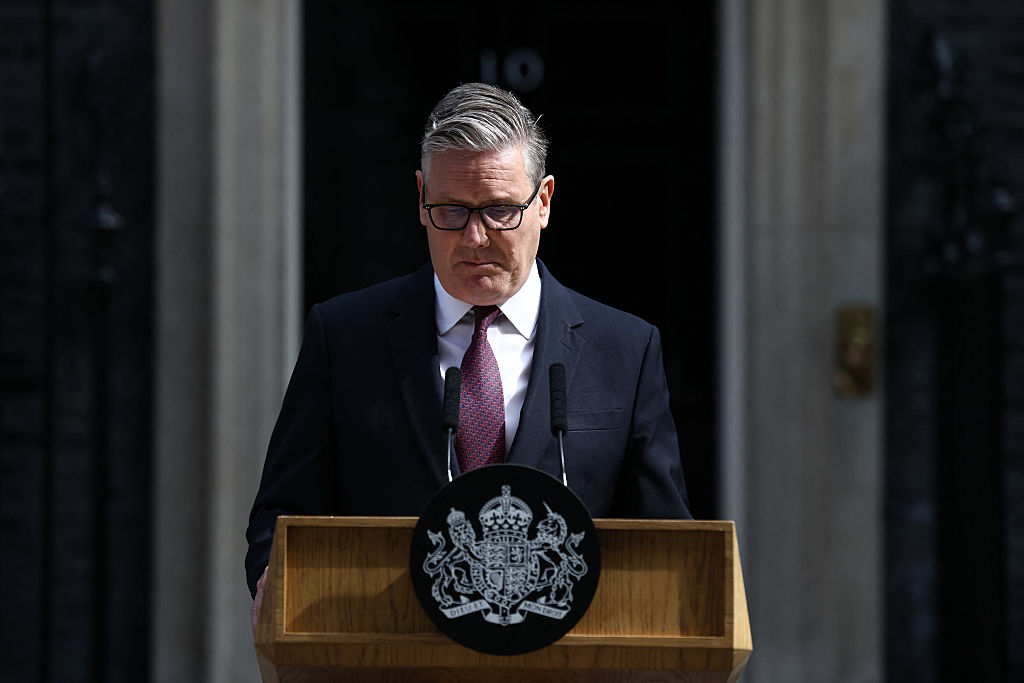
Keir Starmer announces his resignation outside 10 Downing Street this morning. Credit: Getty

Keir Starmer announces his resignation outside 10 Downing Street this morning. Credit: Getty

June 22 2026 - 11:43am

It was difficult, at a purely personal level, not to sympathize with Keir Starmer as he choked back tears at the end of his speech this morning, in which he announced his intention to resign from office. It is never a pretty sight to see a man struck down from the heights he once scaled, and no one should take any particular pleasure in the Prime Minister’s very public humiliation.

Yet his departure followed the pattern of his premiership. Until the very last moment, Starmer insisted that he would fight on. As late as Friday, he had vowed that he was “not going to walk away”. His media surrogates then spent the weekend repeating that line, only for him to do what everyone knew he was going to do and U-turn this morning.

If there is one thing Starmer liked to talk about, it was fighting. Whenever he encountered a crisis, he would give a speech and vow to fight. Last month, ahead of the Unite the Kingdom march, he proclaimed that “we’re in a fight for the soul of this country.” In February, after Scottish Labour leader Anas Sarwar called for him to go, the PM said: “I will never walk away from the people that I’m charged with fighting for.” At last year’s Labour Party conference, amid general unpopularity, he insisted: “I will fight with every breath I have.”

Then, having vowed to fight on, he would return to doing whatever he had been doing, having mistaken the act of talking about fighting for the activities associated with it. When a prime minister, in the full bloom of his power, engages in fighting talk, one cannot help but be impressed — at least the first time. But by the end of his time in office, his rhetoric had become a symbol of his impotence.

What did Starmer want to fight for, in any case? Assisted suicide? The Republic of Mauritius? Internet censorship? His causes and passions were as inexplicable as his political judgment. He spent his political capital on the most bizarre causes. But don’t worry: he will fight for you, or so he said.

This is not to say that Starmer was a pushover. He was perfectly capable of fighting, as long as it involved his internal party enemies. Jeremy Corbyn, Diane Abbott, and even relatively inoffensive figures such as Karl Turner were kicked out. Labour’s National Executive Committee was packed with yes-men. At last month’s local elections, almost 1,500 Labour councillors were lost to ensure that Andy Burnham’s trip to No. 10 would be delayed.

Starmer’s notions of personal responsibility extended only as far as the throwing distance between the person standing next to him and the nearest autobus. Sue Gray was handpicked, then forced out. Olly Robbins was sacked for appointing the man Starmer had personally chosen to send to Washington, D.C. Chris Wormald was personally chosen by the PM despite advice to the contrary, then sacked for… what exactly? Starmer’s inability to convince the country to stop hating him?

On that final point, it has become commonplace on the commentariat Left to express amazement at the degree to which Starmer is loathed across the United Kingdom. He is a good man, they say, and does not deserve the hatred, despite his flaws.

But what evidence do we have for Starmer’s status as a good man? The consideration with which he stabbed others? The high-mindedness with which he accepted free suits from Lord Alli? The ease with which he speaks of his siblings’ poverty in stump speeches while he himself is a multimillionaire?

The truth is that Starmer is neither a saint nor an evil man. He has his flaws, like everybody else. That, in and of itself, is not disqualifying, either for Downing Street or for anything else. But the gap between the Starmer who existed in his mind — competent, the savior of his party and his country — and the real Starmer was large, and it kept growing. Voters could sense it, even if he and his media supporters could not. He covered up his glaring inadequacies through loud proclamations about his fighting spirit. The public, not as stupid as the pundits think they are, understood this, and treated him with the contempt that he richly deserved.

The tragedy of Starmer’s career is that it did not have to end like this. In the normal course of events, he would have made a good solicitor general in a lean year. But fate elevated him to the highest office that the son of a toolmaker could achieve, and then brought him crashing down.


Yuan Yi Zhu is an academic and writer.

yuanyi_z

China is threatening America in the AI race

Reports sugget Zhipu AI  has released a new model that can rival leading US systems. Credit: Getty

Reports sugget Zhipu AI has released a new model that can rival leading US systems. Credit: Getty

July 1 2026 - 10:18am

China is trying to catch up with America on artificial intelligence. The Wall Street Journal has reported that Zhipu AI — one of China’s six “AI tiger” LLMs — has released a new model that can rival leading US systems, including Anthropic’s Mythos, in cybersecurity tasks such as pinpointing security bugs. While this marks a milestone in China’s drive to catch up with Western AI capabilities, strong performance on a single benchmark does not mean it has taken the lead. Chinese models still lag behind their Western counterparts in broader capabilities, such as autonomous operation. Skepticism is therefore warranted before resorting to hysterical conclusions, but complacency about the geopolitical implications of China’s AI advances would be an even greater mistake.

On the infrastructure side, Chinese AI is still constrained by access to advanced chips, with American labs way ahead in computing capacity as well as investment. Analysis from earlier this year suggests that Chinese models are likely to be at least a few months behind those in the US. But they are still continuing to make progress, or that the geopolitical importance of AI will be decided only by whose LLM has ventured deeper into the technological frontier. The practical applications of AI, countries’ to capture foreign markets, and the application of AI into the real economy will matter just as much.

Here, China may hold an advantage. As with its dominance across many critical supply chains, Beijing may not need to produce the most advanced AI systems — only those that are affordable and widely deployable. In doing so, it could consolidate global influence by supplying functional, low-cost AI at scale.

Beijing seems to be pursuing exactly that path, developing an AI “open-source” strategy that offers affordable, widely available AI models for companies and individuals to use and modify as they wish. The production of the DeepSeek AI model, which matched the performance of Silicon Valley tools such as ChatGPT at a fraction of the cost for users, created goodwill among Chinese models with developers.

The four most popular models on OpenRouter, an AI hardware platform for developers, are now all Chinese. The goal for China is not only to win the frontier-model race, but to make its systems the default layer of AI adoption across industries and global markets. For most economies, the choice is increasingly between an affordable tool they can deploy now and a more robust one that may be out of reach.

And while the countries adopting Chinese models may be exposed to political pressure and cyber threats from Beijing, safer and more capable alternatives matter little if they are unaffordable. American AI companies are already under pressure to monetize products whose operating costs are rising. If Chinese open-source models become the cheap default for startups, universities, governments and businesses across the developing world, then America’s AI lead will be eroded from below.

Perhaps more concerning for America in the long run is how AI can give Chinese manufacturing even more strength, through the ongoing integration of AI as a general-purpose technology. China’s new Five-Year Plan mentioned AI more than 50 times and includes an “AI+” action plan aimed at spreading AI across the economy.

Beijing has been pioneering automation of its critical infrastructure for years, with promising recent results in increasing warplane production capacity. In that regard, China’s open-model strategy and manufacturing dominance will reinforce each other. Cheap, adaptable models accelerate deployment across the real economy while those deployments generate real-world data and use cases that can feed back into further model improvement.

The United States should not dismiss the importance of its lead in the AI race. That lead worries Beijing, not least because a more automated Chinese economy would also become more vulnerable to AI-generated cyber threats. But nor should Washington assume that China cannot catch up with American capabilities over time.

This AI competition represents part of a broader struggle over tech supply chains and geopolitical influence. Decisions over whether to adopt US or Chinese models could produce a more fragmented global reality, with different regions relying on different cloud providers, chips and security structures. The result will likely be a global economy which is divided into competing spheres, rather than one which produces a single winner.


Miquel Vila is a political and geopolitical risk consultant focusing on industrial strategy, critical infrastructure and global supply chains.

miquelvilam