



X Close

AI revolution will crush the blue states

Amazon, Intel, Microsoft and Meta have all conducted significant lay-offs of junior coders. Credit: Getty

Amazon, Intel, Microsoft and Meta have all conducted significant lay-offs of junior coders. Credit: Getty

August 24 2025 - 4:00pm

“The first step onto the corporate ladder is vanishing for many new graduates,” argued a recent Fortune report. As a result, CEOs are warning that entry-level jobs are on the brink of extinction, with internships and opportunities for college graduates drying up.

Of course, not everyone will feel the impact in the same way. At the top of the pyramid are investors, entrepreneurs, and elite programmers who now command salaries on par with professional athletes. But artificial intelligence — fueled by a huge infusion of Wall Street cash — threatens to eliminate many software jobs, along with high-end professional roles that involve routine analysis.

Young people are acutely aware of this. In the class I teach with Marshall Koplansky at Chapman University, several students predicted that the jobs they currently hold will soon disappear. Among them were a game designer, two human-resources executives, and a manufacturing and warehouse manager.

My engineering colleagues report a similar trend. While opportunities remain strong for mechanical and chemical engineers, as well as for those designing robotics, the outlook is far less certain for computer science students. Despite soaring profits at the largest tech companies, AI programming tools have enabled sweeping layoffs at firms such as AmazonIntelMeta and Microsoft. Today, among college graduates aged 22-27, computer science and computer engineering majors face some of the highest unemployment rates, according to a report from the Federal Reserve Bank of New York.

In response, many firms are now focusing on building tangible products rather than merely shifting algorithms for commerce or generating more social media. In the aerospace and defense sectors, for example, AI is seen not as an end but a tool. It is a means to enhance human creativity and productivity rather than replace it. “Software is not in the greatest position with AI,” Delian Asparouhov, who runs a firm focused on in-space manufacturing, told me. “Now people are shifting to hard tech. Designing and building spaceships still needs people.”

This could spell trouble for elite universities, but represents a major advantage for schools that teach the practical skills companies actually need. So far, these opportunities are largely concentrated in red and purple states in the Midwest and South — the regions most focused on reshoring manufacturing and other industries from overseas.

Attitudes are shifting alongside these economic changes. One recent survey found that roughly 83% of Generation Z feel that learning a skilled trade can be a better pathway to economic security than college — including 90% of those already holding college degrees. Indeed, as college enrollment has dropped between 2020 and 2023, trade school enrollment grew by 10%. These changes suggest that as practical skills gain value, regions offering them are likely to attract both talent and jobs.

California is already losing hard tech jobs to emerging players in Texas and the South. Between 2022 and 2023, Texas led the country in new tech jobs, while California remained largely flat. Florida came in second, with Georgia, Tennessee, and North Carolina also posting significant gains. Looking ahead, CompTIA (the Computing Technology Association) projects that Texas, Mississippi, Tennessee, and South Carolina will see the fastest growth in tech over the next decade.

The blue-red state divide could widen with AI, given its soaring demand for affordable electricity. California’s high energy prices — the highest in the nation — are one reason why companies building AI servers, advanced chips, and quantum hardware — such as Nvidia, Samsung, and Taiwan Semiconductor — are located in energy-rich states like Texas. Meanwhile, Pennsylvania’s new energy boom is widely seen as an ideal opportunity to expand both its tech and industrial base. For example, in 2022 Shell invested $6 billion in an ethane cracker in Monaca, Pennsylvania, converting the region’s abundant natural gas into plastics.

Artificial intelligence is reshaping the economic landscape, rewarding regions with affordable energy, practical skills, and a willingness to build tangible products. As California’s high costs and stagnant growth push tech jobs to Texas, the South, and Pennsylvania, the winners are likely to be those states that combine infrastructure, talent, and a pragmatic approach to industry. The question is no longer just about innovation — it’s about where that innovation can thrive, and which states are ready to seize the opportunities AI creates.


Joel Kotkin is a Presidential Fellow in Urban Futures at Chapman University and a Senior Research Fellow at the Civitas Institute, the University of Texas at Austin.

joelkotkin

China is threatening America in the AI race

Reports sugget Zhipu AI  has released a new model that can rival leading US systems. Credit: Getty

Reports sugget Zhipu AI has released a new model that can rival leading US systems. Credit: Getty

July 1 2026 - 10:18am

China is trying to catch up with America on artificial intelligence. The Wall Street Journal has reported that Zhipu AI — one of China’s six “AI tiger” LLMs — has released a new model that can rival leading US systems, including Anthropic’s Mythos, in cybersecurity tasks such as pinpointing security bugs. While this marks a milestone in China’s drive to catch up with Western AI capabilities, strong performance on a single benchmark does not mean it has taken the lead. Chinese models still lag behind their Western counterparts in broader capabilities, such as autonomous operation. Skepticism is therefore warranted before resorting to hysterical conclusions, but complacency about the geopolitical implications of China’s AI advances would be an even greater mistake.

On the infrastructure side, Chinese AI is still constrained by access to advanced chips, with American labs way ahead in computing capacity as well as investment. Analysis from earlier this year suggests that Chinese models are likely to be at least a few months behind those in the US. But they are still continuing to make progress, or that the geopolitical importance of AI will be decided only by whose LLM has ventured deeper into the technological frontier. The practical applications of AI, countries’ to capture foreign markets, and the application of AI into the real economy will matter just as much.

Here, China may hold an advantage. As with its dominance across many critical supply chains, Beijing may not need to produce the most advanced AI systems — only those that are affordable and widely deployable. In doing so, it could consolidate global influence by supplying functional, low-cost AI at scale.

Beijing seems to be pursuing exactly that path, developing an AI “open-source” strategy that offers affordable, widely available AI models for companies and individuals to use and modify as they wish. The production of the DeepSeek AI model, which matched the performance of Silicon Valley tools such as ChatGPT at a fraction of the cost for users, created goodwill among Chinese models with developers.

The four most popular models on OpenRouter, an AI hardware platform for developers, are now all Chinese. The goal for China is not only to win the frontier-model race, but to make its systems the default layer of AI adoption across industries and global markets. For most economies, the choice is increasingly between an affordable tool they can deploy now and a more robust one that may be out of reach.

And while the countries adopting Chinese models may be exposed to political pressure and cyber threats from Beijing, safer and more capable alternatives matter little if they are unaffordable. American AI companies are already under pressure to monetize products whose operating costs are rising. If Chinese open-source models become the cheap default for startups, universities, governments and businesses across the developing world, then America’s AI lead will be eroded from below.

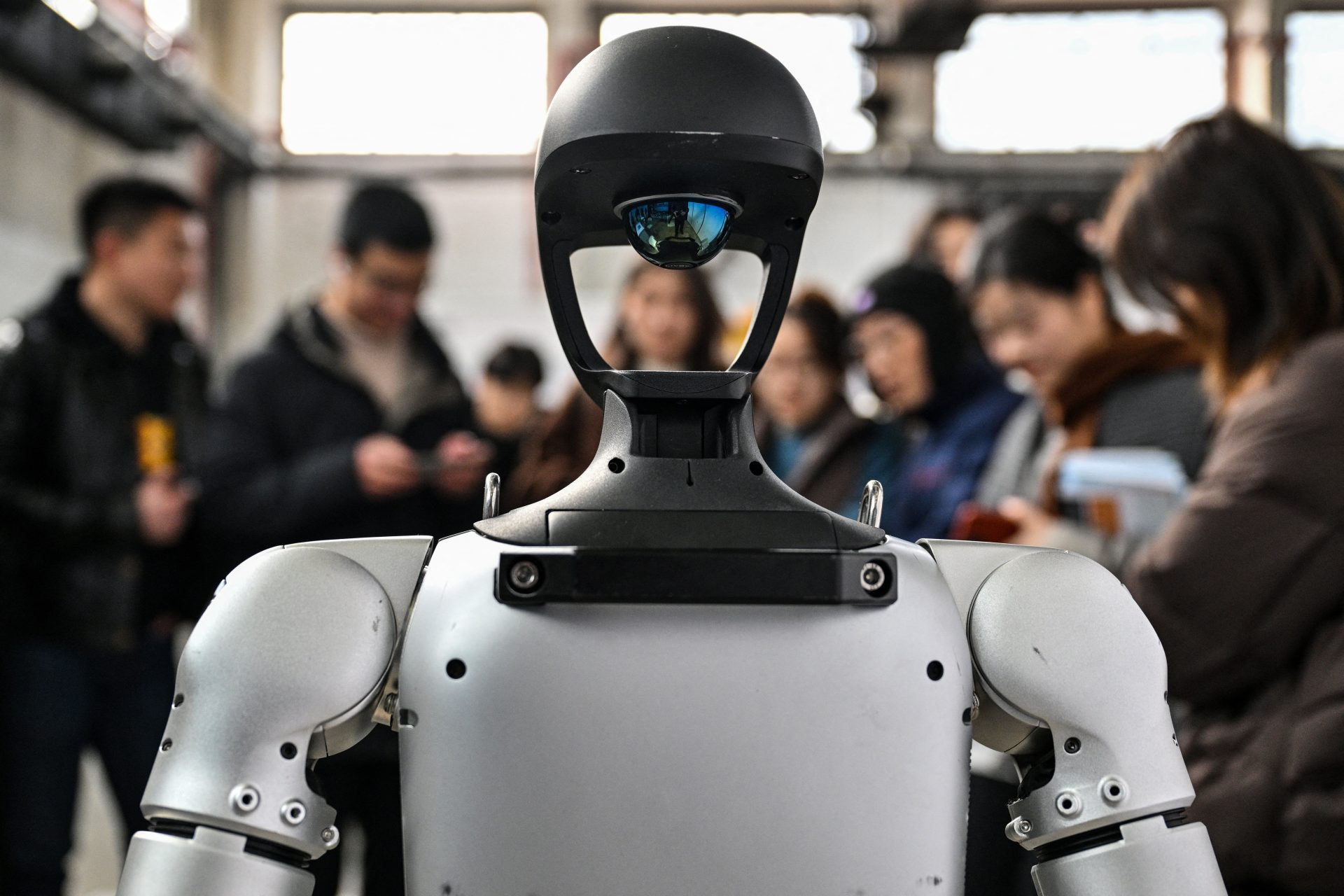
Perhaps more concerning for America in the long run is how AI can give Chinese manufacturing even more strength, through the ongoing integration of AI as a general-purpose technology. China’s new Five-Year Plan mentioned AI more than 50 times and includes an “AI+” action plan aimed at spreading AI across the economy.

Beijing has been pioneering automation of its critical infrastructure for years, with promising recent results in increasing warplane production capacity. In that regard, China’s open-model strategy and manufacturing dominance will reinforce each other. Cheap, adaptable models accelerate deployment across the real economy while those deployments generate real-world data and use cases that can feed back into further model improvement.

The United States should not dismiss the importance of its lead in the AI race. That lead worries Beijing, not least because a more automated Chinese economy would also become more vulnerable to AI-generated cyber threats. But nor should Washington assume that China cannot catch up with American capabilities over time.

This AI competition represents part of a broader struggle over tech supply chains and geopolitical influence. Decisions over whether to adopt US or Chinese models could produce a more fragmented global reality, with different regions relying on different cloud providers, chips and security structures. The result will likely be a global economy which is divided into competing spheres, rather than one which produces a single winner.


Miquel Vila is a political and geopolitical risk consultant focusing on industrial strategy, critical infrastructure and global supply chains.

miquelvilam