
X Close

Ghislaine Maxwell has given Trump a get-out-of-jail-free card

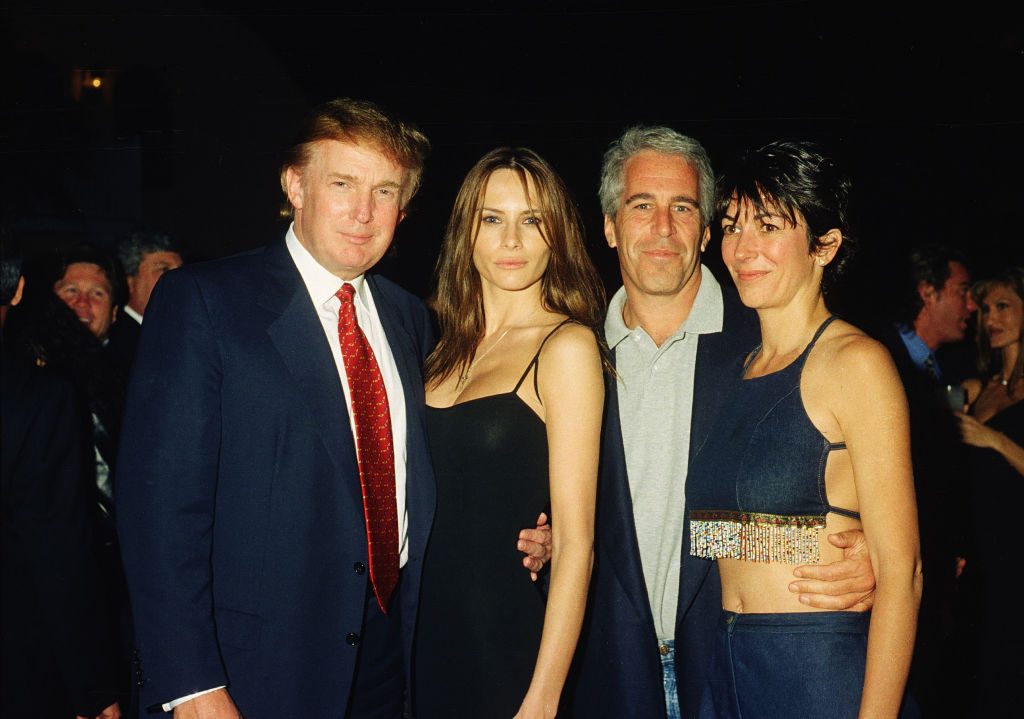
Donald Trump pictured with Ghislaine Maxwell and Jeffrey Epstein at Mar-a-Lago in 2000. Credit: Getty

Donald Trump pictured with Ghislaine Maxwell and Jeffrey Epstein at Mar-a-Lago in 2000. Credit: Getty

August 23 2025 - 6:15pm

Yesterday, the US Justice Department published the full transcript of Deputy Attorney General Todd Blanche’s two-day interview with Ghislaine Maxwell from last month. The timing is no accident. Maxwell, serving 20 years for sex trafficking, was asked about “potentially 100 different people” during questioning in Tallahassee, Florida. Days later, she was moved to a lower-security prison in Texas. Now we may know why.

Maxwell’s testimony about Donald Trump’s ties to Jeffrey Epstein reads like she’s taking one for the team. Asked if she ever saw the President receive a massage, she responded: “Never.” What about inappropriate behavior? He was “a gentleman in all respects”. Did anyone ever suggest Trump did anything wrong with masseuses or anybody else? “Absolutely never, in any context.”

But Maxwell didn’t stop at denials. She volunteered that Trump was “always very cordial and very kind to me” and added: “I admire his extraordinary achievement in becoming the president now. And I like him, and I’ve always liked him.” She even offered, without being asked, to provide materials showing how “the President got swept into some of this unnecessarily” by people trying to harm him.

As is so often the case in MAGA world, everyone who comes around to working with Trump ends up praising him in weirdly specific ways. Ahead of his first term, his personal physician Harold Bornstein literally let Trump dictate his own medical letter, which highlighted his “extraordinary” health and declared that he’d be “the healthiest individual ever elected to the presidency”. Bornstein admitted in 2018 that Trump wrote the whole thing himself.

Mitt Romney learned this lesson the hard way. After calling Trump a “phoney” and a “fraud” during the 2016 campaign, Romney met with him multiple times about the secretary of state position, gushing about their “wonderful evening” over dinner because, as he revealed in Romney: A Reckoning, he still wanted the role but refused to apologize in the manner Trump would have liked. Trump later claimed he never intended to give his rival the job, and that he just wanted to “prove a point, that Mitt Romney is, and always has been, a lightweight joke”.

Maxwell has clearly got the memo. During her interview, she claimed she didn’t recall recruiting masseuses from Mar-a-Lago, while acknowledging that it was “possible”. This conveniently matches Trump’s recent claim that Epstein “poached” young women from his property. She only saw Trump in “social settings”, never at Epstein’s houses. Every answer fits perfectly with the defense Trump has been building.

The timing couldn’t be better for the President’s broader strategy of turning defense into attack.  Director of National Intelligence Tulsi Gabbard has declared that Barack Obama “manufactured and politicized intelligence” to create a “years-long coup” against Trump. The President himself has accused Obama of treason for allegedly pushing the false theory of Russian involvement in the 2016 election. Yesterday, in another escalation, the FBI raided former national security advisor John Bolton’s home searching for classified documents.

With Maxwell’s help, the MAGA coalition can speed past Epstein and focus on its real enemies, including Obama and Bolton. Her testimony, fawning and fulsome though it might be, gives otherwise conflicted supporters permission to stop thinking about the Epstein scandal. Will she convince the conspiracy theorists, doubters, fence-sitters, and partisan Democrats? Of course not. But Trump doesn’t need to convince everyone: he just needs enough cover to move on.

It doesn’t matter whether Maxwell is angling for a pardon, or looking for a better place to serve out a reduced prison sentence, or genuinely believes what she’s saying. The effect is the same. Over the course of two days in July, she gave Trump what money can’t buy and investigations can’t provide: a convicted co-conspirator insisting, apparently against all her own interests, that he’s a gentleman who did nothing wrong.

In contemporary American politics, that’s enough to close one chapter and open another — from defending against the Epstein allegations to investigating old foes such as Bolton. The circus continues, just with different performers in the ring.


Oliver Bateman is a historian and journalist based in Pittsburgh. He blogs, vlogs, and podcasts at his Substack, Oliver Bateman Does the Work

MoustacheClubUS

China is threatening America in the AI race

Reports sugget Zhipu AI  has released a new model that can rival leading US systems. Credit: Getty

Reports sugget Zhipu AI has released a new model that can rival leading US systems. Credit: Getty

July 1 2026 - 10:18am

China is trying to catch up with America on artificial intelligence. The Wall Street Journal has reported that Zhipu AI — one of China’s six “AI tiger” LLMs — has released a new model that can rival leading US systems, including Anthropic’s Mythos, in cybersecurity tasks such as pinpointing security bugs. While this marks a milestone in China’s drive to catch up with Western AI capabilities, strong performance on a single benchmark does not mean it has taken the lead. Chinese models still lag behind their Western counterparts in broader capabilities, such as autonomous operation. Skepticism is therefore warranted before resorting to hysterical conclusions, but complacency about the geopolitical implications of China’s AI advances would be an even greater mistake.

On the infrastructure side, Chinese AI is still constrained by access to advanced chips, with American labs way ahead in computing capacity as well as investment. Analysis from earlier this year suggests that Chinese models are likely to be at least a few months behind those in the US. But they are still continuing to make progress, or that the geopolitical importance of AI will be decided only by whose LLM has ventured deeper into the technological frontier. The practical applications of AI, countries’ to capture foreign markets, and the application of AI into the real economy will matter just as much.

Here, China may hold an advantage. As with its dominance across many critical supply chains, Beijing may not need to produce the most advanced AI systems — only those that are affordable and widely deployable. In doing so, it could consolidate global influence by supplying functional, low-cost AI at scale.

Beijing seems to be pursuing exactly that path, developing an AI “open-source” strategy that offers affordable, widely available AI models for companies and individuals to use and modify as they wish. The production of the DeepSeek AI model, which matched the performance of Silicon Valley tools such as ChatGPT at a fraction of the cost for users, created goodwill among Chinese models with developers.

The four most popular models on OpenRouter, an AI hardware platform for developers, are now all Chinese. The goal for China is not only to win the frontier-model race, but to make its systems the default layer of AI adoption across industries and global markets. For most economies, the choice is increasingly between an affordable tool they can deploy now and a more robust one that may be out of reach.

And while the countries adopting Chinese models may be exposed to political pressure and cyber threats from Beijing, safer and more capable alternatives matter little if they are unaffordable. American AI companies are already under pressure to monetize products whose operating costs are rising. If Chinese open-source models become the cheap default for startups, universities, governments and businesses across the developing world, then America’s AI lead will be eroded from below.

Perhaps more concerning for America in the long run is how AI can give Chinese manufacturing even more strength, through the ongoing integration of AI as a general-purpose technology. China’s new Five-Year Plan mentioned AI more than 50 times and includes an “AI+” action plan aimed at spreading AI across the economy.

Beijing has been pioneering automation of its critical infrastructure for years, with promising recent results in increasing warplane production capacity. In that regard, China’s open-model strategy and manufacturing dominance will reinforce each other. Cheap, adaptable models accelerate deployment across the real economy while those deployments generate real-world data and use cases that can feed back into further model improvement.

The United States should not dismiss the importance of its lead in the AI race. That lead worries Beijing, not least because a more automated Chinese economy would also become more vulnerable to AI-generated cyber threats. But nor should Washington assume that China cannot catch up with American capabilities over time.

This AI competition represents part of a broader struggle over tech supply chains and geopolitical influence. Decisions over whether to adopt US or Chinese models could produce a more fragmented global reality, with different regions relying on different cloud providers, chips and security structures. The result will likely be a global economy which is divided into competing spheres, rather than one which produces a single winner.


Miquel Vila is a political and geopolitical risk consultant focusing on industrial strategy, critical infrastructure and global supply chains.

miquelvilam