

X Close

Macron-Merz bromance can’t hide tensions in Europe

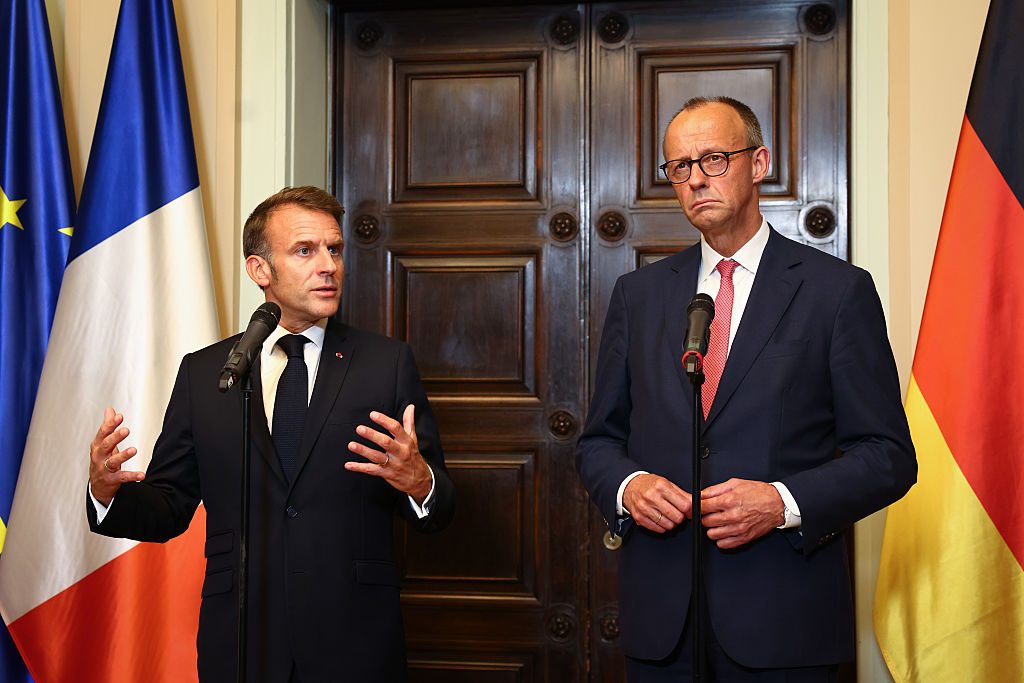
'All the hugging and backslapping can’t detract from the divergence of national interests.' Credit: Getty

'All the hugging and backslapping can’t detract from the divergence of national interests.' Credit: Getty

July 24 2025 - 10:00am

“Bienvenue à Berlin,” said a smiling Friedrich Merz as he greeted Emmanuel Macron last night in the German capital. A firm handshake and a hearty hug followed, with the German Chancellor and the French President visibly keen to convey that they get along well. The warmth between them is genuine, but is it enough to bridge the deep rifts emerging between their countries?

Merz certainly wants to move on from the notoriously frosty relations his predecessor Olaf Scholz had with Macron. Instead of inviting the Frenchman to the chancellery, Merz arranged for a “working dinner” at the Villa Borsig, a beautiful lakeside mansion that served as the residence of the French military governor in occupied Berlin — a potent symbol of reconciliation. “We stand on the foundations of a close Franco-German relationship that has grown over decades,” Merz told the media. “Both of us see it as a great duty to continue to work on it for years to come.”

Few would doubt that Merz and Macron really want a “fresh start” for Franco-German relations. The common challenges facing Europe are huge. Ahead of the meeting, Merz mentioned that a solution for the ongoing trade negotiations with the US might be nigh. However, there are other, much more contentious issues between Berlin and Paris in crucial areas, such as defense integration, energy security and their vision for Europe.

In theory, both Germany and France agree that European countries must invest more in their own security while reducing dependency on the US. At their last meeting in May, when Merz visited Paris on his first day in office, they announced the creation of a Franco-German Defence and Security Council. There is also a push on joint programmes such as the Future Combat Air System (FCAS). But friction remains. France demands intellectual and industrial leadership over the project, with its companies arguing that they have more experience in the field.

Macron also continues to push for European “strategic autonomy” anchored in France’s nuclear deterrent. Germany, which doesn’t have its own nuclear weapons, has long had a strong military relationship with the US. Merz, despite having made huge debt-sourced funds available for German rearmament, insists NATO remains central. As a staunch transatlanticist, he argues France’s nuclear role must complement, rather than replace, the American umbrella.

Meanwhile, Berlin and Paris are diametrically opposed on energy policy. France creates nearly 70% of its electricity from nuclear power and is lobbying the EU to label the sector as “green”, which would then make it eligible for subsidies and beneficial legislation. Germany, having exited nuclear entirely in 2023, has resisted, banking on gas imports instead. Merz’s administration, though critical of the phase-out completed under Scholz, has ruled out reversing the decision. This has vast implications for security and supply within an increasingly integrated electricity market in the EU, where German industry ramps up its imports when the sun doesn’t shine enough and there isn’t enough wind to create what it needs from renewables.

There is more alignment on trade policy. Both Paris and Berlin want to prepare Europe for a tougher, more fragmented global economy with increased autonomy from the US, Russia and China. This pragmatic shift has revived the E3 format between Germany, France, and Britain, as emphasised in recent meetings between UK Prime Minister Keir Starmer with Macron and Merz. But there is a risk that this format neglects Poland. As Germany and France deepen ties with London, Poland — Europe’s rising power in defense and diplomacy — is conspicuously absent. Recent presidential elections there were won by the conservative candidate Karol Nawrocki, who has been critical of Germany and the EU. Keeping Poland on side, especially when it comes to defense, will be crucial.

The “Merzcron” relationship is a far cry from the cold mutual suspicion between Scholz and the French President. But all the hugging and backslapping can’t detract from the divergence of national interests. Personal chemistry and shared ambition can smooth over tensions — but they can’t erase the deeper structural divides that shape each country’s vision of Europe.


Katja Hoyer is a German-British historian and writer. Her latest book Weimar: Life on the Edge of Catastrophe will be released in May 2026.

hoyer_kat

China is threatening America in the AI race

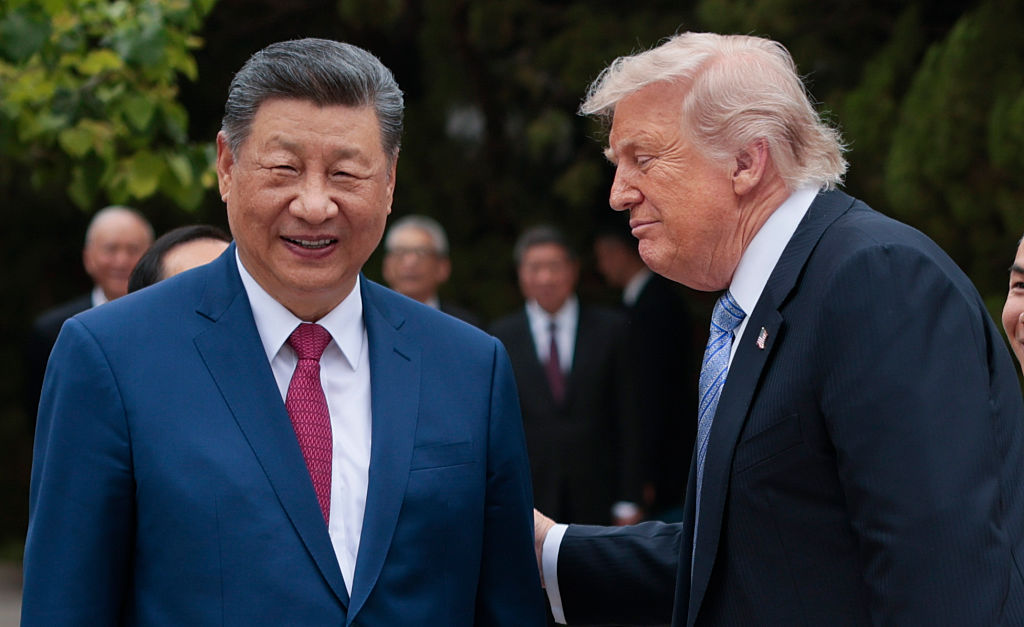
Reports sugget Zhipu AI  has released a new model that can rival leading US systems. Credit: Getty

Reports sugget Zhipu AI has released a new model that can rival leading US systems. Credit: Getty

July 1 2026 - 10:18am

China is trying to catch up with America on artificial intelligence. The Wall Street Journal has reported that Zhipu AI — one of China’s six “AI tiger” LLMs — has released a new model that can rival leading US systems, including Anthropic’s Mythos, in cybersecurity tasks such as pinpointing security bugs. While this marks a milestone in China’s drive to catch up with Western AI capabilities, strong performance on a single benchmark does not mean it has taken the lead. Chinese models still lag behind their Western counterparts in broader capabilities, such as autonomous operation. Skepticism is therefore warranted before resorting to hysterical conclusions, but complacency about the geopolitical implications of China’s AI advances would be an even greater mistake.

On the infrastructure side, Chinese AI is still constrained by access to advanced chips, with American labs way ahead in computing capacity as well as investment. Analysis from earlier this year suggests that Chinese models are likely to be at least a few months behind those in the US. But they are still continuing to make progress, or that the geopolitical importance of AI will be decided only by whose LLM has ventured deeper into the technological frontier. The practical applications of AI, countries’ to capture foreign markets, and the application of AI into the real economy will matter just as much.

Here, China may hold an advantage. As with its dominance across many critical supply chains, Beijing may not need to produce the most advanced AI systems — only those that are affordable and widely deployable. In doing so, it could consolidate global influence by supplying functional, low-cost AI at scale.

Beijing seems to be pursuing exactly that path, developing an AI “open-source” strategy that offers affordable, widely available AI models for companies and individuals to use and modify as they wish. The production of the DeepSeek AI model, which matched the performance of Silicon Valley tools such as ChatGPT at a fraction of the cost for users, created goodwill among Chinese models with developers.

The four most popular models on OpenRouter, an AI hardware platform for developers, are now all Chinese. The goal for China is not only to win the frontier-model race, but to make its systems the default layer of AI adoption across industries and global markets. For most economies, the choice is increasingly between an affordable tool they can deploy now and a more robust one that may be out of reach.

And while the countries adopting Chinese models may be exposed to political pressure and cyber threats from Beijing, safer and more capable alternatives matter little if they are unaffordable. American AI companies are already under pressure to monetize products whose operating costs are rising. If Chinese open-source models become the cheap default for startups, universities, governments and businesses across the developing world, then America’s AI lead will be eroded from below.

Perhaps more concerning for America in the long run is how AI can give Chinese manufacturing even more strength, through the ongoing integration of AI as a general-purpose technology. China’s new Five-Year Plan mentioned AI more than 50 times and includes an “AI+” action plan aimed at spreading AI across the economy.

Beijing has been pioneering automation of its critical infrastructure for years, with promising recent results in increasing warplane production capacity. In that regard, China’s open-model strategy and manufacturing dominance will reinforce each other. Cheap, adaptable models accelerate deployment across the real economy while those deployments generate real-world data and use cases that can feed back into further model improvement.

The United States should not dismiss the importance of its lead in the AI race. That lead worries Beijing, not least because a more automated Chinese economy would also become more vulnerable to AI-generated cyber threats. But nor should Washington assume that China cannot catch up with American capabilities over time.

This AI competition represents part of a broader struggle over tech supply chains and geopolitical influence. Decisions over whether to adopt US or Chinese models could produce a more fragmented global reality, with different regions relying on different cloud providers, chips and security structures. The result will likely be a global economy which is divided into competing spheres, rather than one which produces a single winner.


Miquel Vila is a political and geopolitical risk consultant focusing on industrial strategy, critical infrastructure and global supply chains.

miquelvilam