




X Close

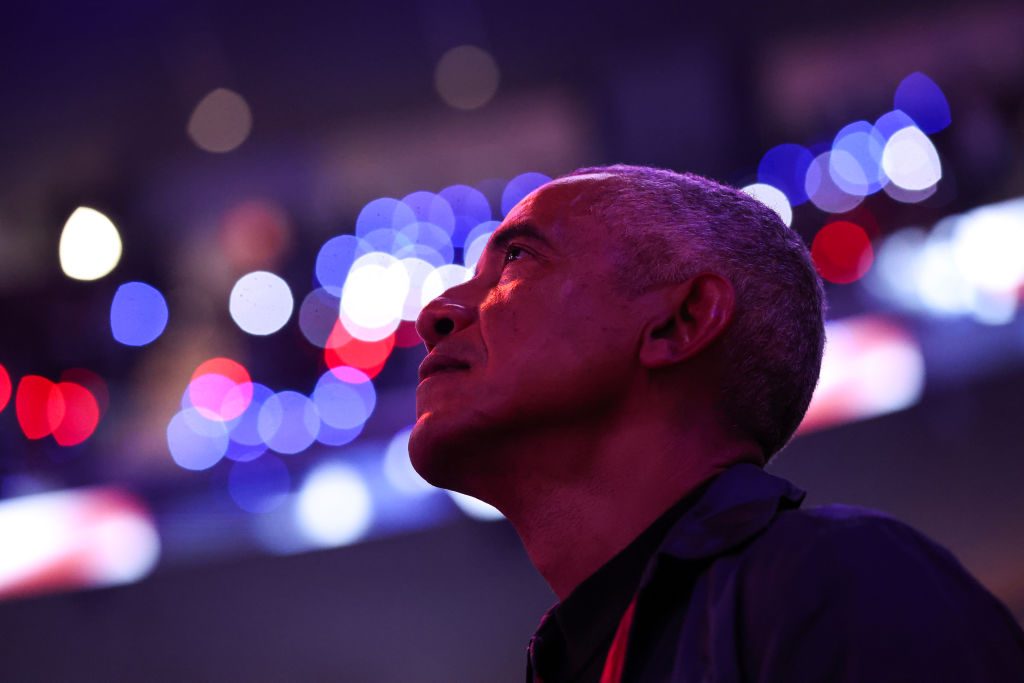
Is Barack Obama plotting a comeback?

Yes, he can. Credit: Getty

Yes, he can. Credit: Getty

July 13 2025 - 7:30pm

“Hope and change” is back on the trail. Barack Obama this week launched a new fundraising campaign, and is soon to embark on a high profile (and high-priced) appearance in London.

Last month, his YouTube channel uploaded its first video in more than a decade. The former president may be angling to fill the Democrats’ leadership vacuum, but he was himself instrumental in bringing the party to its current political impasse.

Since last November’s election, the Democratic Party has lacked a clear leader. Dispatched by his own party a year ago (reportedly at Obama’s own urging), Joe Biden has been transformed into a scapegoat for the Democrats’ political travails. Kamala Harris remains a hazy “vibes” avatar. The party’s congressional leadership has not yet been able to unify around a central message. All this suggests an opening for Obama, still vital at only 63. Having served two terms in the presidency, he is ineligible to return to the White House, but he might hope that his continued prominence allows him to play a kingmaker role in the 2026 midterms as well as the 2028 Democratic primary.

Yet Obama was largely responsible for formulating the paradigm that has become a strategic box canyon for his party. At the core of his pitch in 2008 was the idea that he would dispense with the triangulation of the Clinton years and instead create a more ideologically uniform Democratic Party, especially on social issues.

In terms of coalitional transformation, Obama was successful. Democratic politicians became increasingly hostile to any restrictions on abortion. Especially during his second term, the party began to swing far to the Left on immigration. More broadly, the “Great Awokening” began to consolidate during his presidency. As journalist John B. Judis and political scientist Ruy Teixeira documented in their 2023 book Where Have All the Democrats Gone?, the Obama years saw an accelerated migration of affluent suburbanites into the Democratic coalition, and the dissatisfaction which followed the Great Recession helped lay the groundwork for waves of populist unrest, from the Tea Party to Occupy Wall Street to the Trump phenomenon. The Obama dispensation birthed a more ideologically unified but also narrower Democratic Party, one that was increasingly unable to compete in rural and exurban areas and has now lost ground even among working-class urban voters.

Despite the generational differences between the two men, the Biden presidency was to some degree the extension of the Obama paradigm. On economics, Biden leaned in a somewhat more populist direction than his Democratic predecessor, but he continued Obama’s rush to the Left on many social issues. Biden’s equity agenda enshrined radical identity politics throughout the federal government, and the breakdown at the border realized the vision of progressive immigration activists from the Obama years. Department of Homeland Security chief Alejandro Mayorkas, the man deputized by Biden to detonate border controls, served as deputy secretary of DHS under Obama. He was also a principal actor in implementing Obama’s DACA program, which was a revolutionary use of executive discretion to grant legal status to a bloc of illegal immigrants.

Yet the very strength of the Obama paradigm within Democratic circles has invited backlash from voters. On social issues ranging from gender to immigration, the party’s elites remain out of step with the American public. Democratic leaders may hope that they can return to power by riding an anti-Trump wave, and Obama sounded some “Resistance”-like notes in the appearance uploaded to his YouTube channel last month.

This could prove a fraught gamble, however. In part because of the failures of the Biden presidency, Trump remains more popular than he was during his first term. The narrowness of the current Democratic coalition limits its ability to win in many rural states. Unless it addresses the structural causes for its current weakness, the party is set for a prolonged political exile.

Fred Bauer is a writer from New England.

fredbauerblog

China is threatening America in the AI race

Reports sugget Zhipu AI  has released a new model that can rival leading US systems. Credit: Getty

Reports sugget Zhipu AI has released a new model that can rival leading US systems. Credit: Getty

July 1 2026 - 10:18am

China is trying to catch up with America on artificial intelligence. The Wall Street Journal has reported that Zhipu AI — one of China’s six “AI tiger” LLMs — has released a new model that can rival leading US systems, including Anthropic’s Mythos, in cybersecurity tasks such as pinpointing security bugs. While this marks a milestone in China’s drive to catch up with Western AI capabilities, strong performance on a single benchmark does not mean it has taken the lead. Chinese models still lag behind their Western counterparts in broader capabilities, such as autonomous operation. Skepticism is therefore warranted before resorting to hysterical conclusions, but complacency about the geopolitical implications of China’s AI advances would be an even greater mistake.

On the infrastructure side, Chinese AI is still constrained by access to advanced chips, with American labs way ahead in computing capacity as well as investment. Analysis from earlier this year suggests that Chinese models are likely to be at least a few months behind those in the US. But they are still continuing to make progress, or that the geopolitical importance of AI will be decided only by whose LLM has ventured deeper into the technological frontier. The practical applications of AI, countries’ to capture foreign markets, and the application of AI into the real economy will matter just as much.

Here, China may hold an advantage. As with its dominance across many critical supply chains, Beijing may not need to produce the most advanced AI systems — only those that are affordable and widely deployable. In doing so, it could consolidate global influence by supplying functional, low-cost AI at scale.

Beijing seems to be pursuing exactly that path, developing an AI “open-source” strategy that offers affordable, widely available AI models for companies and individuals to use and modify as they wish. The production of the DeepSeek AI model, which matched the performance of Silicon Valley tools such as ChatGPT at a fraction of the cost for users, created goodwill among Chinese models with developers.

The four most popular models on OpenRouter, an AI hardware platform for developers, are now all Chinese. The goal for China is not only to win the frontier-model race, but to make its systems the default layer of AI adoption across industries and global markets. For most economies, the choice is increasingly between an affordable tool they can deploy now and a more robust one that may be out of reach.

And while the countries adopting Chinese models may be exposed to political pressure and cyber threats from Beijing, safer and more capable alternatives matter little if they are unaffordable. American AI companies are already under pressure to monetize products whose operating costs are rising. If Chinese open-source models become the cheap default for startups, universities, governments and businesses across the developing world, then America’s AI lead will be eroded from below.

Perhaps more concerning for America in the long run is how AI can give Chinese manufacturing even more strength, through the ongoing integration of AI as a general-purpose technology. China’s new Five-Year Plan mentioned AI more than 50 times and includes an “AI+” action plan aimed at spreading AI across the economy.

Beijing has been pioneering automation of its critical infrastructure for years, with promising recent results in increasing warplane production capacity. In that regard, China’s open-model strategy and manufacturing dominance will reinforce each other. Cheap, adaptable models accelerate deployment across the real economy while those deployments generate real-world data and use cases that can feed back into further model improvement.

The United States should not dismiss the importance of its lead in the AI race. That lead worries Beijing, not least because a more automated Chinese economy would also become more vulnerable to AI-generated cyber threats. But nor should Washington assume that China cannot catch up with American capabilities over time.

This AI competition represents part of a broader struggle over tech supply chains and geopolitical influence. Decisions over whether to adopt US or Chinese models could produce a more fragmented global reality, with different regions relying on different cloud providers, chips and security structures. The result will likely be a global economy which is divided into competing spheres, rather than one which produces a single winner.


Miquel Vila is a political and geopolitical risk consultant focusing on industrial strategy, critical infrastructure and global supply chains.

miquelvilam