
X Close

Zohran Mamdani heralds a new era of Democratic politics

The self-avowed socialist speaks to a dispirited generation. Credit: Getty

The self-avowed socialist speaks to a dispirited generation. Credit: Getty

June 25 2025 - 10:00am

The heat in New York City last night wasn’t just meteorological. On one of the hottest days in memory, socialist candidate Zohran Mamdani declared victory in the Democratic primary for the role of mayor of New York City. Andrew Cuomo, conceding the race, looked exactly like what he was: a relic from an exhausted political tradition that had finally run out of gas.

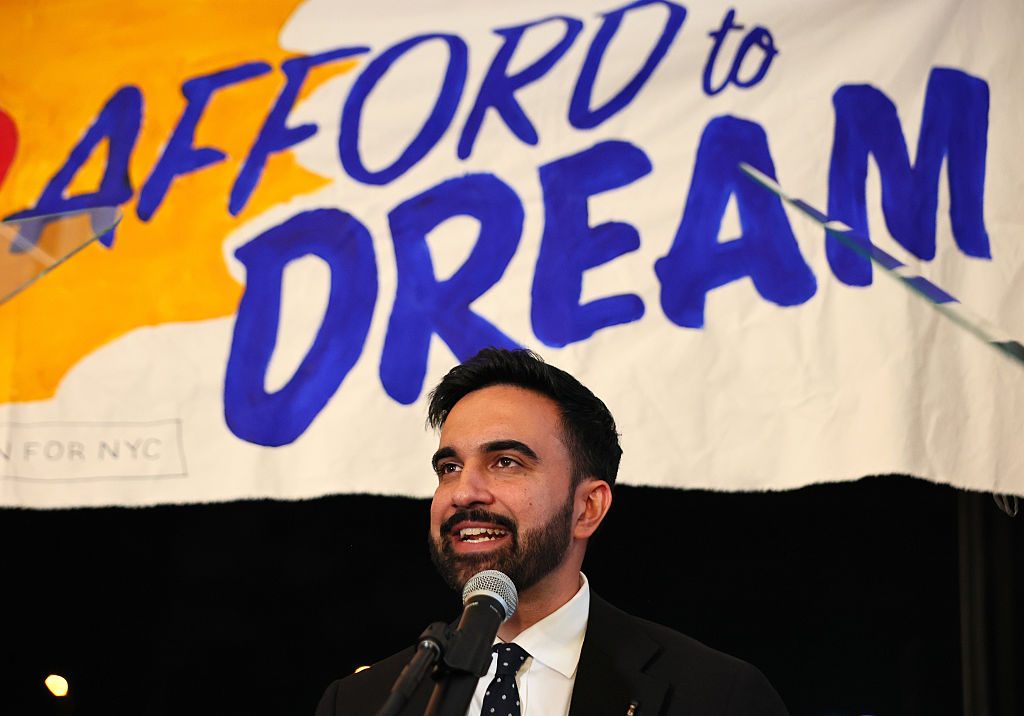
The numbers told the story clearly enough. “Together, we have shown the power of the politics of the future, one of partnership and of sincerity,” Mamdani said after pulling ahead by tens of thousands of votes in the first round of ranked-choice voting last night. But the real story wasn’t in the vote tallies — it was in who showed up to cast them. Under-employed 20- and 30-somethings, single mothers, immigrants: Marx’s much-maligned lumpenproletariat turned out in force for the 33-year-old assemblyman.

Mamdani’s pitch was simple: the cost of living is crushing working people but the municipal government can lower costs and make life easier. He vowed to bring down rent, boost the standard of public transit, and support families. These are hardly radical ideas. Really, they are basic social-democratic policies which wouldn’t raise an eyebrow in Berlin or Barcelona. But in American politics, particularly in the Democratic Party’s calcified center-left wing, they represented something genuinely threatening: actual change.

The man Mamdani defeated embodies everything wrong with that dying tradition. Cuomo, 67, followed in his father Mario’s footsteps in serving 10 years as governor until he was forced to resign amid accusations of corruption, mishandling the Covid-19 pandemic in nursing homes, and — most seriously — alleged sexual harassment of a dozen women. While Mamdani’s own parents are prominent — his father a Left-wing academic, his mother an award-winning filmmaker — he provides a stark contrast with Cuomo: the scion of dynastic machine politics pitted against the charismatic outsider backed by actual ideas.

What made Mamdani different from the Squad and other progressive standard-bearers was his sheer efficiency, not his platform. His fundraising, driven by small donors, has topped $8 million, and he has dubbed his campaign the “largest volunteer operation in NYC history”. Unlike typical progressive campaigns, he managed to pull together a top-to-bottom cultural coalition — from kingmaker congresswoman Alexandria Ocasio-Cortez  to “dirtbag Left” podcasters such as Nick Mullen fame and Will Menaker.

The generational divide was impossible to ignore in the lead-up to the election. By late May, Mamdani led among voters under 50, white New Yorkers, and college-educated voters by double-digit margins, then increased those numbers on election day. Young people, facing impossible rents and diminishing prospects, finally found someone speaking their language rather than the consultant-tested pablum of establishment Democrats.

Mamdani’s energetic campaign videos pledged to make the city affordable for the working class, and received widespread pick-up across social media platforms including Instagram and TikTok. While Cuomo relied on a record-setting super PAC inundating voters with anti-Mamdani ads and promising to hold the line on Israel, the socialist candidate built something more powerful: enthusiasm backed by past successes such as his debt relief campaign for the city’s beleaguered medallion-holding taxi drivers.

Will many New Yorkers have faith in Mamdani’s policies? Perhaps not. Free buses and rent freezes sound lovely until you start asking about municipal budgets and state preemption. City-run grocery stores? Ask anyone who’s dealt with New York City bureaucracy about that one. But compared to the scandal-stained alternative of Cuomo, at least Mamdani represents something, as journalist Yasha Levine noted when arguing that this was far preferable to nihilistic quiescence.

Because of his history of activism and charisma, some have compared Mamdani’s meteoric rise to that of Barack Obama. That may be overstating things, but the establishment has certainly taken notice. And they should be terrified — not because Mamdani is a revolutionary, given that his policies are pretty milquetoast by global standards, but because he represents the end of their cozy arrangement with Democratic machine politics.

Last night’s result was about a generation who have watched their prospects shrink while being told to be grateful for scraps. They finally found someone who spoke to their reality rather than lecturing them about pragmatism. Whether Mamdani can actually govern is another question entirely. But for one sweltering June night, the kids finally showed up and the old guard discovered their time was over.


Oliver Bateman is a historian and journalist based in Pittsburgh. He blogs, vlogs, and podcasts at his Substack, Oliver Bateman Does the Work

MoustacheClubUS

China is threatening America in the AI race

Reports sugget Zhipu AI  has released a new model that can rival leading US systems. Credit: Getty

Reports sugget Zhipu AI has released a new model that can rival leading US systems. Credit: Getty

July 1 2026 - 10:18am

China is trying to catch up with America on artificial intelligence. The Wall Street Journal has reported that Zhipu AI — one of China’s six “AI tiger” LLMs — has released a new model that can rival leading US systems, including Anthropic’s Mythos, in cybersecurity tasks such as pinpointing security bugs. While this marks a milestone in China’s drive to catch up with Western AI capabilities, strong performance on a single benchmark does not mean it has taken the lead. Chinese models still lag behind their Western counterparts in broader capabilities, such as autonomous operation. Skepticism is therefore warranted before resorting to hysterical conclusions, but complacency about the geopolitical implications of China’s AI advances would be an even greater mistake.

On the infrastructure side, Chinese AI is still constrained by access to advanced chips, with American labs way ahead in computing capacity as well as investment. Analysis from earlier this year suggests that Chinese models are likely to be at least a few months behind those in the US. But they are still continuing to make progress, or that the geopolitical importance of AI will be decided only by whose LLM has ventured deeper into the technological frontier. The practical applications of AI, countries’ to capture foreign markets, and the application of AI into the real economy will matter just as much.

Here, China may hold an advantage. As with its dominance across many critical supply chains, Beijing may not need to produce the most advanced AI systems — only those that are affordable and widely deployable. In doing so, it could consolidate global influence by supplying functional, low-cost AI at scale.

Beijing seems to be pursuing exactly that path, developing an AI “open-source” strategy that offers affordable, widely available AI models for companies and individuals to use and modify as they wish. The production of the DeepSeek AI model, which matched the performance of Silicon Valley tools such as ChatGPT at a fraction of the cost for users, created goodwill among Chinese models with developers.

The four most popular models on OpenRouter, an AI hardware platform for developers, are now all Chinese. The goal for China is not only to win the frontier-model race, but to make its systems the default layer of AI adoption across industries and global markets. For most economies, the choice is increasingly between an affordable tool they can deploy now and a more robust one that may be out of reach.

And while the countries adopting Chinese models may be exposed to political pressure and cyber threats from Beijing, safer and more capable alternatives matter little if they are unaffordable. American AI companies are already under pressure to monetize products whose operating costs are rising. If Chinese open-source models become the cheap default for startups, universities, governments and businesses across the developing world, then America’s AI lead will be eroded from below.

Perhaps more concerning for America in the long run is how AI can give Chinese manufacturing even more strength, through the ongoing integration of AI as a general-purpose technology. China’s new Five-Year Plan mentioned AI more than 50 times and includes an “AI+” action plan aimed at spreading AI across the economy.

Beijing has been pioneering automation of its critical infrastructure for years, with promising recent results in increasing warplane production capacity. In that regard, China’s open-model strategy and manufacturing dominance will reinforce each other. Cheap, adaptable models accelerate deployment across the real economy while those deployments generate real-world data and use cases that can feed back into further model improvement.

The United States should not dismiss the importance of its lead in the AI race. That lead worries Beijing, not least because a more automated Chinese economy would also become more vulnerable to AI-generated cyber threats. But nor should Washington assume that China cannot catch up with American capabilities over time.

This AI competition represents part of a broader struggle over tech supply chains and geopolitical influence. Decisions over whether to adopt US or Chinese models could produce a more fragmented global reality, with different regions relying on different cloud providers, chips and security structures. The result will likely be a global economy which is divided into competing spheres, rather than one which produces a single winner.


Miquel Vila is a political and geopolitical risk consultant focusing on industrial strategy, critical infrastructure and global supply chains.

miquelvilam