




X Close

Black Sea ceasefire would endanger Ukraine

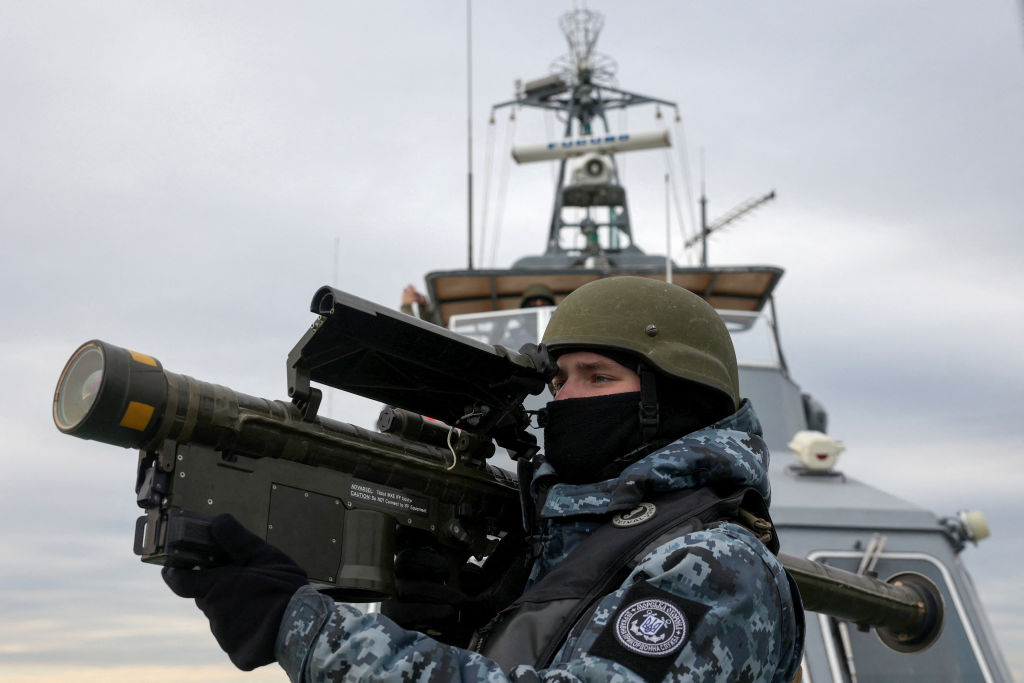
A truce at sea plays to Moscow's advantage. Credit: Getty

A truce at sea plays to Moscow's advantage. Credit: Getty

March 25 2025 - 7:00am

Discussions yesterday between Russian and American negotiators in Saudi Arabia focused on a topic which seems, at first glance, an uncontroversial first step to a broader peace deal. US National Security Advisor Mike Waltz said that they would focus on a “maritime ceasefire so that both sides can move grain, fuel, and start conducting trade again in the Black Sea”.

For his part, Russian leader Vladimir Putin indicated last week that he was “favorable” towards implementing “a well-known proposal regarding the safety of navigation in the Black Sea”. He was referring to the 2022 grain deal from which Moscow withdrew the following year, claiming that the West was not fulfilling the conditions to enable Russian agricultural exports.

The Kremlin’s interest is unsurprising, since it stands to gain significantly from such a truce. Ukraine has enjoyed remarkable success in challenging Russia for control of the Black Sea. Kyiv successfully forced Russia’s navy out of the western part, disrupting Russian logistics and assisting Ukrainian attacks on occupied Crimea, and also reports having “fire control” over the neighboring Sea of Azov.

Ukraine has taken advantage of this to re-establish its main grain export route, nearing pre-war volumes and enjoying a much-needed economic boost. In contrast, following its withdrawal from the grain deal, Moscow complained of being unable to trade food and fertilizer products, making it likely that the Kremlin will now use its rapprochement with the US to push for greater liberalization. Having adapted successfully, Ukraine has little to gain.

That is before one turns to the broader impact of a truce on regional safety. Romanian and Bulgarian officials have already confessed to worries that such a ceasefire will expand the Russian navy’s operational area. Moscow has traditionally valued the Black Sea as an important space for projecting power into the Mediterranean, Middle East and Europe, meaning the Kremlin will eagerly take advantage of its newfound freedom of movement to expand its influence abroad. Then there is the issue of sequencing. Resolving the issue of the Black Sea now, before negotiations about a broader ceasefire, deprives Ukraine of a potential bargaining chip in those subsequent peace talks.

There are further signs of these early stages benefiting Moscow. Both sides have accepted in principle a moratorium on energy strikes. However, that does not take into consideration that, although Russia and Ukraine have attacked one another’s energy infrastructure during the conflict, these hits have functioned very differently. Kyiv’s strikes on Russia’s oil facilities have managed to harm the production and revenues that Moscow needs to sustain its war effort, with the potential to continue indefinitely. By contrast, Russian strikes on Ukrainian energy facilities have aimed at sapping morale by plunging civilians into freezing temperatures. As such, Moscow’s agreement to halt attacks on energy infrastructure is less of a concession than it is for Kyiv, winter having now passed.

With Waltz saying that the US may ask Russia to return abducted Ukrainian children as a “confidence-building measure”, we might then see how the Kremlin approaches a purely Ukrainian demand from which it cannot benefit. Russia will likely create obstacles or delays in the hope of the issue being lost or traded in the broader mix of peace negotiations to come.

These early stages are supposed to build confidence, but Ukraine won’t be feeling that way. In a far-reaching interview with Time magazine yesterday, Zelensky seemed increasingly pessimistic, saying that he thinks “Russia has managed to influence some people on the White House team”. Russia has given no indication of making any genuine concessions, and is getting back into the Black Sea after all Kyiv’s efforts to force it out. Last week, US Special Envoy Steve Witkoff revealed Putin’s claim to have prayed for the US President’s recovery from an assassination attempt. It was perhaps a rare moment of honesty from the Russian leader: his prayers are being swiftly answered.

Bethany Elliott is a writer specialising in Russia and Eastern Europe.

BethanyAElliott

China is threatening America in the AI race

Reports sugget Zhipu AI  has released a new model that can rival leading US systems. Credit: Getty

Reports sugget Zhipu AI has released a new model that can rival leading US systems. Credit: Getty

July 1 2026 - 10:18am

China is trying to catch up with America on artificial intelligence. The Wall Street Journal has reported that Zhipu AI — one of China’s six “AI tiger” LLMs — has released a new model that can rival leading US systems, including Anthropic’s Mythos, in cybersecurity tasks such as pinpointing security bugs. While this marks a milestone in China’s drive to catch up with Western AI capabilities, strong performance on a single benchmark does not mean it has taken the lead. Chinese models still lag behind their Western counterparts in broader capabilities, such as autonomous operation. Skepticism is therefore warranted before resorting to hysterical conclusions, but complacency about the geopolitical implications of China’s AI advances would be an even greater mistake.

On the infrastructure side, Chinese AI is still constrained by access to advanced chips, with American labs way ahead in computing capacity as well as investment. Analysis from earlier this year suggests that Chinese models are likely to be at least a few months behind those in the US. But they are still continuing to make progress, or that the geopolitical importance of AI will be decided only by whose LLM has ventured deeper into the technological frontier. The practical applications of AI, countries’ to capture foreign markets, and the application of AI into the real economy will matter just as much.

Here, China may hold an advantage. As with its dominance across many critical supply chains, Beijing may not need to produce the most advanced AI systems — only those that are affordable and widely deployable. In doing so, it could consolidate global influence by supplying functional, low-cost AI at scale.

Beijing seems to be pursuing exactly that path, developing an AI “open-source” strategy that offers affordable, widely available AI models for companies and individuals to use and modify as they wish. The production of the DeepSeek AI model, which matched the performance of Silicon Valley tools such as ChatGPT at a fraction of the cost for users, created goodwill among Chinese models with developers.

The four most popular models on OpenRouter, an AI hardware platform for developers, are now all Chinese. The goal for China is not only to win the frontier-model race, but to make its systems the default layer of AI adoption across industries and global markets. For most economies, the choice is increasingly between an affordable tool they can deploy now and a more robust one that may be out of reach.

And while the countries adopting Chinese models may be exposed to political pressure and cyber threats from Beijing, safer and more capable alternatives matter little if they are unaffordable. American AI companies are already under pressure to monetize products whose operating costs are rising. If Chinese open-source models become the cheap default for startups, universities, governments and businesses across the developing world, then America’s AI lead will be eroded from below.

Perhaps more concerning for America in the long run is how AI can give Chinese manufacturing even more strength, through the ongoing integration of AI as a general-purpose technology. China’s new Five-Year Plan mentioned AI more than 50 times and includes an “AI+” action plan aimed at spreading AI across the economy.

Beijing has been pioneering automation of its critical infrastructure for years, with promising recent results in increasing warplane production capacity. In that regard, China’s open-model strategy and manufacturing dominance will reinforce each other. Cheap, adaptable models accelerate deployment across the real economy while those deployments generate real-world data and use cases that can feed back into further model improvement.

The United States should not dismiss the importance of its lead in the AI race. That lead worries Beijing, not least because a more automated Chinese economy would also become more vulnerable to AI-generated cyber threats. But nor should Washington assume that China cannot catch up with American capabilities over time.

This AI competition represents part of a broader struggle over tech supply chains and geopolitical influence. Decisions over whether to adopt US or Chinese models could produce a more fragmented global reality, with different regions relying on different cloud providers, chips and security structures. The result will likely be a global economy which is divided into competing spheres, rather than one which produces a single winner.


Miquel Vila is a political and geopolitical risk consultant focusing on industrial strategy, critical infrastructure and global supply chains.

miquelvilam