




X Close

Does Reform have a Ukraine problem?

Ukraine or USA? Credit: Getty

Ukraine or USA? Credit: Getty

February 21 2025 - 1:00pm

One million votes. That is one insider’s estimate of the damage caused to Reform UK at the last election when Nigel Farage seemed to suggest that the West was to blame for Russia’s invasion of Ukraine.

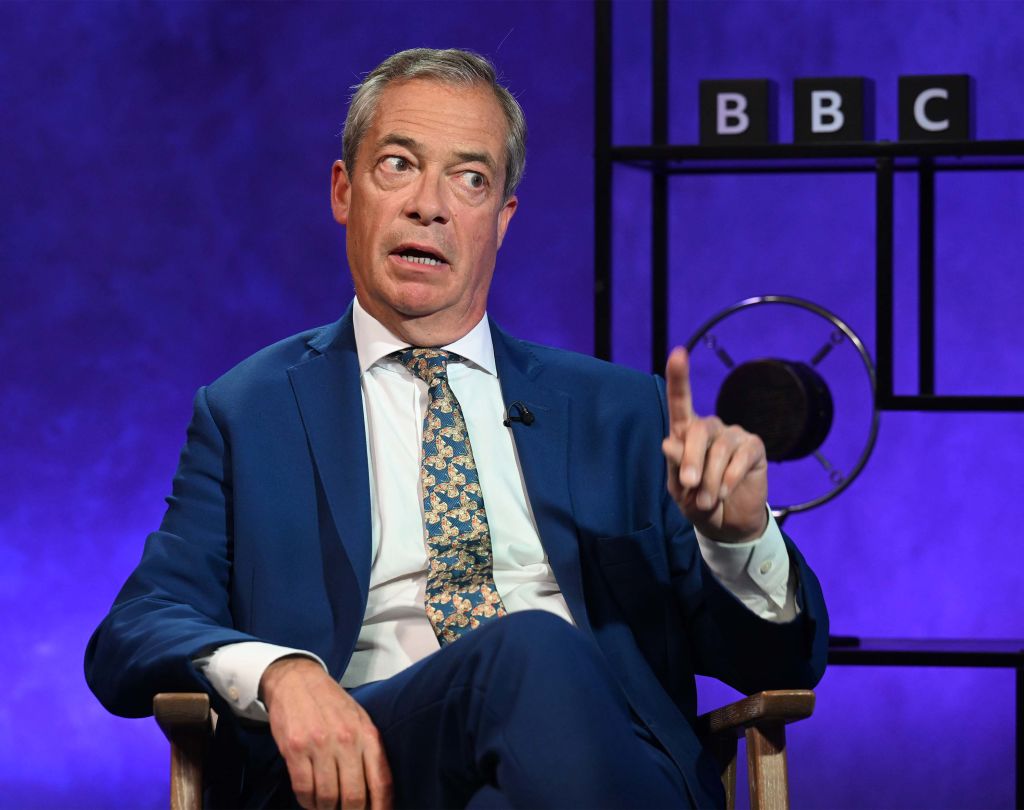
“It came up on the doors straight away and never stopped being raised. I have no doubt that it cost us several more MPs,” says this source. In a pre-election interview with the BBC’s Nick Robinson, Farage claimed that “we’ve provoked this war”. For a leader to show a lack of moral clarity about Vladimir Putin’s obviously despicable expansionist regime is one of the few foreign policy no-nos that domestic UK public opinion is likely to punish severely.

Indeed, many Labour insiders date the start of the downfall of Jeremy Corbyn to his performance during the Salisbury poisoning episode. The former Labour leader suggested that a sample of the Novichok nerve agent used be sent to the Kremlin so Russia could determine if it was theirs or not. His rather popular “Magic Grandpa” identity quickly morphed into an instant corpse.

So is Farage now in danger of doing the same to his own “man of the people” mega-brand that has done so much to redraw the usual contours of British politics? Over the past week, as Donald Trump has relentlessly insulted Ukrainian leader Volodymyr Zelensky, Reform’s MPs and its normally effusive party chairman have succumbed to a rare dose of “cat got your tongue?” syndrome.

That ended overnight, with Farage having no option but to talk about the issue during his customary visit to the CPAC conference of American Right-wingers, being held this week in Maryland. Interviewed by Sky News, he relied on the curious phrase that what Donald Trump says should be taken “truthfully, not literally” when asked if he agreed with the US President’s view that Ukraine “never should have started” the war.

“Putin started the war. We all know that. What he’s talking about are the causal factors that go back for years,” Farage said. “He promised a negotiation. He promised he’d talk to Putin. And he is. This is progress. We may not at the moment like how it looks, but we haven’t seen the final shape of the deal.” He also called on Zelensky to set a timeline for domestic elections, while not endorsing Trump’s claim that the Ukrainian leader is a dictator.

Before the tumult, Farage had actually laid down a very different marker on Ukraine. On 12 February, he told GB News viewers: “I think Ukraine now joining NATO is almost an essential part of this peace deal.” This provoked a flurry of “what did he mean by that?” discussions within Tory WhatsApp groups. But since then, nothing further has been heard of Farage’s backing for Ukraine’s most cherished goal — something which is clearly not on Trump’s agenda.

Up until now, Trump’s sweeping election victory in November has been all roses for Farage. Reform-curious voters in Britain have lapped up Trump’s hardline approach to issues ranging from illegal migration to gender ideology. Farage has gained both in profile and authority from his connections with Team Trump.

Yet there was always going to come a moment when the rogue elephant in the White House started trampling on British sensibilities. Opinion polling suggests the British public holds firm to its view of Zelensky and Ukraine being the heroic underdogs and Putin and Russia the evil invaders. According to YouGov, 74% of the UK public agree with Keir Starmer’s view that it is reasonable for a country not to hold elections while fighting a war within its own borders. Even 66% of Reform voters take this view.

YouGov also found that the British public remains steadfast overall in its support for Ukraine, with 48% even thinking that Britain backing Ukraine is more important than keeping good relations with the US. Just 20% of people feel the opposite. On this issue, Reform voters differed from supporters of other parties, with 28% prioritizing support for Ukraine and 47% keeping in Trump’s good books. Yet that’s still a big chunk of Reform’s existing poll rating that Farage and co risk alienating. Should Trump’s comments result in a peace deal which humiliates Ukraine, one can expect public opinion to harden.

Have Britain’s established political parties finally found an effective line of attack against the upstarts? Shadow Defense Secretary James Cartlidge yesterday said it was “incredibly trite” for Farage to call for Zelensky to hold elections. Lib Dem leader Ed Davey went much further, claiming: “Nigel Farage has chosen to explain away Trump’s outrageous remarks about President Zelensky instead of doing the right thing and condemning them. He sounds like a spokesman for Trump.”

With Reform having announced almost no policy since the election, it has relied on positive opinion poll news to sustain the crucial idea of it being the party with overwhelming momentum. But does it have the substance to grind its way through a significant dip in popularity? We may be about to find out.

Patrick O’Flynn is a former MEP and political editor of the Daily Express.

oflynnsocial

China is threatening America in the AI race

Reports sugget Zhipu AI  has released a new model that can rival leading US systems. Credit: Getty

Reports sugget Zhipu AI has released a new model that can rival leading US systems. Credit: Getty

July 1 2026 - 10:18am

China is trying to catch up with America on artificial intelligence. The Wall Street Journal has reported that Zhipu AI — one of China’s six “AI tiger” LLMs — has released a new model that can rival leading US systems, including Anthropic’s Mythos, in cybersecurity tasks such as pinpointing security bugs. While this marks a milestone in China’s drive to catch up with Western AI capabilities, strong performance on a single benchmark does not mean it has taken the lead. Chinese models still lag behind their Western counterparts in broader capabilities, such as autonomous operation. Skepticism is therefore warranted before resorting to hysterical conclusions, but complacency about the geopolitical implications of China’s AI advances would be an even greater mistake.

On the infrastructure side, Chinese AI is still constrained by access to advanced chips, with American labs way ahead in computing capacity as well as investment. Analysis from earlier this year suggests that Chinese models are likely to be at least a few months behind those in the US. But they are still continuing to make progress, or that the geopolitical importance of AI will be decided only by whose LLM has ventured deeper into the technological frontier. The practical applications of AI, countries’ to capture foreign markets, and the application of AI into the real economy will matter just as much.

Here, China may hold an advantage. As with its dominance across many critical supply chains, Beijing may not need to produce the most advanced AI systems — only those that are affordable and widely deployable. In doing so, it could consolidate global influence by supplying functional, low-cost AI at scale.

Beijing seems to be pursuing exactly that path, developing an AI “open-source” strategy that offers affordable, widely available AI models for companies and individuals to use and modify as they wish. The production of the DeepSeek AI model, which matched the performance of Silicon Valley tools such as ChatGPT at a fraction of the cost for users, created goodwill among Chinese models with developers.

The four most popular models on OpenRouter, an AI hardware platform for developers, are now all Chinese. The goal for China is not only to win the frontier-model race, but to make its systems the default layer of AI adoption across industries and global markets. For most economies, the choice is increasingly between an affordable tool they can deploy now and a more robust one that may be out of reach.

And while the countries adopting Chinese models may be exposed to political pressure and cyber threats from Beijing, safer and more capable alternatives matter little if they are unaffordable. American AI companies are already under pressure to monetize products whose operating costs are rising. If Chinese open-source models become the cheap default for startups, universities, governments and businesses across the developing world, then America’s AI lead will be eroded from below.

Perhaps more concerning for America in the long run is how AI can give Chinese manufacturing even more strength, through the ongoing integration of AI as a general-purpose technology. China’s new Five-Year Plan mentioned AI more than 50 times and includes an “AI+” action plan aimed at spreading AI across the economy.

Beijing has been pioneering automation of its critical infrastructure for years, with promising recent results in increasing warplane production capacity. In that regard, China’s open-model strategy and manufacturing dominance will reinforce each other. Cheap, adaptable models accelerate deployment across the real economy while those deployments generate real-world data and use cases that can feed back into further model improvement.

The United States should not dismiss the importance of its lead in the AI race. That lead worries Beijing, not least because a more automated Chinese economy would also become more vulnerable to AI-generated cyber threats. But nor should Washington assume that China cannot catch up with American capabilities over time.

This AI competition represents part of a broader struggle over tech supply chains and geopolitical influence. Decisions over whether to adopt US or Chinese models could produce a more fragmented global reality, with different regions relying on different cloud providers, chips and security structures. The result will likely be a global economy which is divided into competing spheres, rather than one which produces a single winner.


Miquel Vila is a political and geopolitical risk consultant focusing on industrial strategy, critical infrastructure and global supply chains.

miquelvilam