



X Close

Germany’s election debate presented a false choice

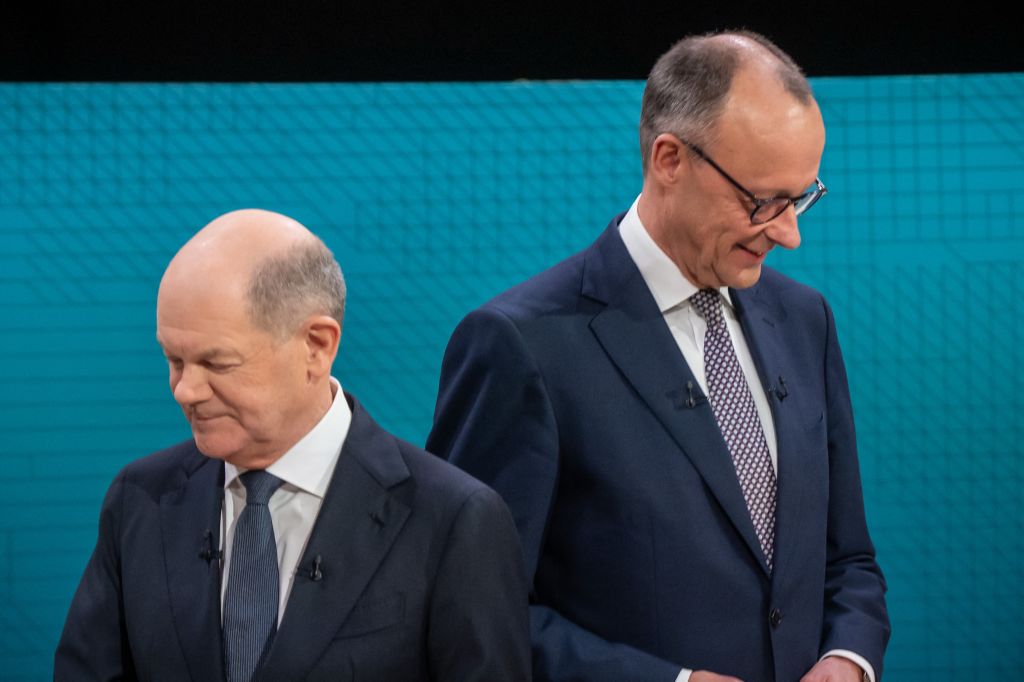
Election rivals or prospective coalition partners? Credit: Getty

Election rivals or prospective coalition partners? Credit: Getty

February 10 2025 - 9:30am

For the first time in years, German voters have a choice between fundamentally different options when they head to the polls on 23 February. Anything from far-Left to far-Right politics is on offer. Yet many feel that real change is frustratingly hard to come by. Last night, a TV debate between Chancellor Olaf Scholz and his likely successor Friedrich Merz reinforced those frustrations rather than allaying them.

“TV duels”, as the German media has dubbed them, are a relatively recent addition to German election campaigns. The first one between two contenders for the chancellorship was in 2002, when SPD chancellor Gerhard Schröder went head-to-head with Edmund Stoiber of the conservative CDU/CSU.

In the end, Schröder remained chancellor, and TV debates remained controversial. Critics saw them as overly American, and wanted to import neither the focus on personalities nor the two-party system. This argument made sense at the time: the SPD and the CDU/CSU each received 38.5% of the vote share, and the vast majority of voters did decide between the two.

Those days are over, though. Polls currently have Merz’s CDU/CSU in the lead with just 30%, followed by the anti-immigration AfD on around 20%. The SPD hovers around 15%, marginally ahead of the Greens. So for Germany’s public broadcasters to host a “duel” between the candidates of the first and the third most popular parties like it’s 2002 seems a little out of time.

But it also highlights a much bigger problem. Voting for change is not as easy as it was two decades ago. Merz has already ruled out working with the AfD, and admitted last night that he will knock on the door of Scholz’s SPD first to form a government. So what German viewers received last night was a game of “Let’s pretend”, in this case that voters have a choice between the two parties when there is a good chance they will get both whatever they do.

Side-by-side rather than head-to-head, Scholz and Merz condemned the AfD and agreed to work with one another after the election — each man careful not to cross a line that would make coalition talks impossible.

The irony is that for the first time in decades, their programs offer real choice. Scholz emphasized his center-left credentials by arguing for the minimum wage to be raised to €15 from €12.82, taxes to go up for high earners, and state subsidies for certain sectors of the economy to be kept in place.

Merz, a former BlackRock executive, argued for a leaner state and tougher immigration laws. In fact, the only time he became visibly emotional was when he spoke about last month’s knife attack in Bavaria, in which a small child and a bystander who tried to intervene were killed by an illegal immigrant.

The CDU leader has seven grandchildren, which might make the issue of illegal immigration and the associated increase in crime more personal to him than others. He even tried to press immediate change on immigration through the German parliament two weeks ago, taking into account that this might pass with AfD votes, which is regarded a taboo in German politics. The fact that the SPD and the Greens voted against this demonstrates the clear blue water between Merz and Scholz.

And yet, despite these very different offerings on the ballot paper, many voters despair at the idea that they cannot find a way to vote for real change. All other parties rule out working with the AfD, which means one or even both of the current coalition partners will be in Merz’s government, slamming the brakes on change — especially regarding immigration, which is currently the biggest concern for voters according to the polls.

What millions of viewers saw last night was not a passionate clash of rivals but preliminary coalition talks. In contrast to 2002, many Germans now don’t feel they get to choose between the two main parties. They know they may well end up with both.


Katja Hoyer is a German-British historian and writer. Her latest book Weimar: Life on the Edge of Catastrophe will be released in May 2026.

hoyer_kat

China is threatening America in the AI race

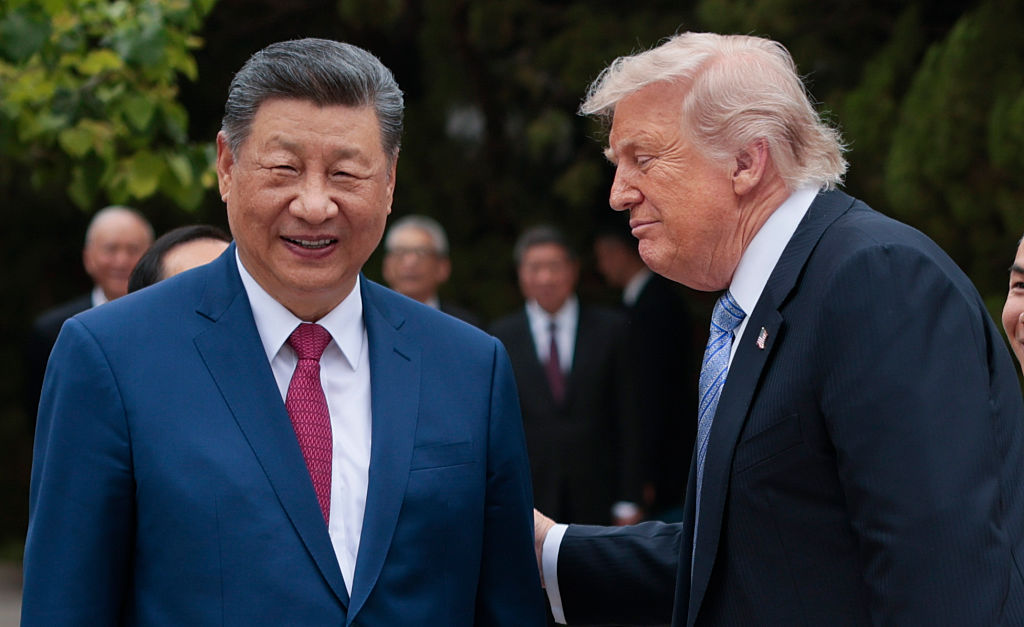
Reports sugget Zhipu AI  has released a new model that can rival leading US systems. Credit: Getty

Reports sugget Zhipu AI has released a new model that can rival leading US systems. Credit: Getty

July 1 2026 - 10:18am

China is trying to catch up with America on artificial intelligence. The Wall Street Journal has reported that Zhipu AI — one of China’s six “AI tiger” LLMs — has released a new model that can rival leading US systems, including Anthropic’s Mythos, in cybersecurity tasks such as pinpointing security bugs. While this marks a milestone in China’s drive to catch up with Western AI capabilities, strong performance on a single benchmark does not mean it has taken the lead. Chinese models still lag behind their Western counterparts in broader capabilities, such as autonomous operation. Skepticism is therefore warranted before resorting to hysterical conclusions, but complacency about the geopolitical implications of China’s AI advances would be an even greater mistake.

On the infrastructure side, Chinese AI is still constrained by access to advanced chips, with American labs way ahead in computing capacity as well as investment. Analysis from earlier this year suggests that Chinese models are likely to be at least a few months behind those in the US. But they are still continuing to make progress, or that the geopolitical importance of AI will be decided only by whose LLM has ventured deeper into the technological frontier. The practical applications of AI, countries’ to capture foreign markets, and the application of AI into the real economy will matter just as much.

Here, China may hold an advantage. As with its dominance across many critical supply chains, Beijing may not need to produce the most advanced AI systems — only those that are affordable and widely deployable. In doing so, it could consolidate global influence by supplying functional, low-cost AI at scale.

Beijing seems to be pursuing exactly that path, developing an AI “open-source” strategy that offers affordable, widely available AI models for companies and individuals to use and modify as they wish. The production of the DeepSeek AI model, which matched the performance of Silicon Valley tools such as ChatGPT at a fraction of the cost for users, created goodwill among Chinese models with developers.

The four most popular models on OpenRouter, an AI hardware platform for developers, are now all Chinese. The goal for China is not only to win the frontier-model race, but to make its systems the default layer of AI adoption across industries and global markets. For most economies, the choice is increasingly between an affordable tool they can deploy now and a more robust one that may be out of reach.

And while the countries adopting Chinese models may be exposed to political pressure and cyber threats from Beijing, safer and more capable alternatives matter little if they are unaffordable. American AI companies are already under pressure to monetize products whose operating costs are rising. If Chinese open-source models become the cheap default for startups, universities, governments and businesses across the developing world, then America’s AI lead will be eroded from below.

Perhaps more concerning for America in the long run is how AI can give Chinese manufacturing even more strength, through the ongoing integration of AI as a general-purpose technology. China’s new Five-Year Plan mentioned AI more than 50 times and includes an “AI+” action plan aimed at spreading AI across the economy.

Beijing has been pioneering automation of its critical infrastructure for years, with promising recent results in increasing warplane production capacity. In that regard, China’s open-model strategy and manufacturing dominance will reinforce each other. Cheap, adaptable models accelerate deployment across the real economy while those deployments generate real-world data and use cases that can feed back into further model improvement.

The United States should not dismiss the importance of its lead in the AI race. That lead worries Beijing, not least because a more automated Chinese economy would also become more vulnerable to AI-generated cyber threats. But nor should Washington assume that China cannot catch up with American capabilities over time.

This AI competition represents part of a broader struggle over tech supply chains and geopolitical influence. Decisions over whether to adopt US or Chinese models could produce a more fragmented global reality, with different regions relying on different cloud providers, chips and security structures. The result will likely be a global economy which is divided into competing spheres, rather than one which produces a single winner.


Miquel Vila is a political and geopolitical risk consultant focusing on industrial strategy, critical infrastructure and global supply chains.

miquelvilam