




X Close

Kamala Harris is trying to be an economic populist

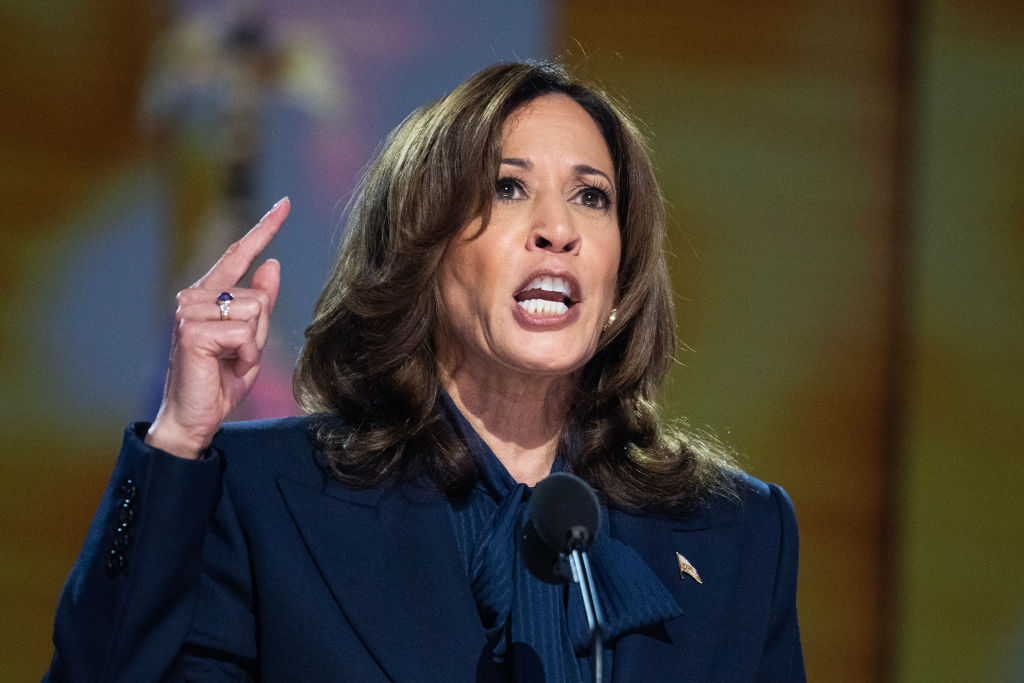
Kamala Harris speaks at the DNC last night. Credit: Getty

Kamala Harris speaks at the DNC last night. Credit: Getty

August 23 2024 - 7:30am

As the Democratic National Convention wraps up in Chicago this week, Kamala Harris and Donald Trump are preparing for a final sprint over the next 74 days. In this time, they will compete for the small slice of the country’s electorate living in battleground states who will decide the presidential election. A key focus of both candidates’ messages to these voters is likely to be the economy, and over the past week we’ve had a sense of what this will look like for the Democrats. That is, an attempt to reclaim economic populism.

This has been evident in a couple of ways. For a start, the party is embracing organized labor — longtime allies of Harris — more tightly than ever. At the outset of the convention, presidents of several of the country’s top unions took turns enthusiastically endorsing her as attendees held signs and chanted: ‘Union yes!’ A prime speaking slot went to Shawn Fain, president of the United Auto Workers, whom Donald Trump made a point of attacking during his own convention speech. In addition to endorsing Harris, Fain took the opportunity to lay into the GOP nominee, calling him a ‘scab’ and asserting that it has been much easier for workers to organize under Joe Biden than under his White House predecessor.

The prominence of labor at the convention is a sign Democrats understand that the institution remains one of their last remaining lifelines to the working class — and that they have work to do to shore up the support of union households, which have been slipping away from them towards Trump. In 2020, Biden won 56% of these voters, marking the second-lowest vote share for a Democratic nominee in nearly 30 years, besting only Hillary Clinton’s 51%. A major driver of this has been the Rightward swing among white union voters, who are more culturally conservative than the Democrats’ base. It remains to be seen whether the party’s overtures on workers’ issues are enough to bridge that divide, but they certainly can’t hurt.

Additionally, Harris has begun rolling out an economic policy agenda for her second term that aims to address a key issue for voters, including those who are undecided: the cost of living. Specifically, she claimed last night that she will work to ‘create jobs, grow our economy, and lower the cost of everyday needs like health care, housing, and groceries’. This includes going after corporations that practice price-gouging, both by imposing penalties on rule-breaking companies and cracking down on unfair mergers which have helped consolidate the food industry. Though economists have broadly pushed back, saying the causes of inflation are multifaceted, many voters — including a majority of Republicans — are supportive.

Harris’s other major policy rollout was designed to help blunt the rising cost of housing. At the core of this idea is an expansion of the nation’s housing supply, which she would facilitate by offering a tax credit to homebuilders who sell starter homes to first-time buyers. This would be coupled with $25,000 in down-payment assistance to first-time buyers, something that Republicans in Congress have already shot down as an inflationary measure but that a majority of Americans support.

Among Harris’s most populist measures is a call to raise $5 trillion in taxes by increasing the burden of the wealthiest Americans and corporations. Though similar calls to reduce income inequality and the national deficit via a more progressive tax code have previously faced rocky political terrain in Congress, most Americans — including a near-majority of Republicans — are supportive. Perhaps just as importantly, swing voters say this policy is among those likeliest to move them to vote for Harris. She also plans to complement this with a middle-class tax cut.

Despite the emergence of these plans over the past week, all of which poll well, Harris’s convention speech last night somewhat inexplicably failed to mention any of these measures except the tax cut, marking a missed opportunity to connect with viewers who did not know much about her agenda. To the extent that the Vice President touched on policy, she spoke in platitudes about ‘lowering costs’, ‘ending the housing shortage’, and ‘providing access to capital’ for small businesses and entrepreneurs — all laudable ideas but without much substance for voters to consider.

Heading into the home stretch of the campaign, voters continue to say they trust Trump more than Harris to handle economic issues. But Harris has a clear and popular agenda that could tip the scales more in her favor. She also has a massive war chest with which to communicate this message to the handful of undecided voters who will determine the next president. Pushing a more populist vision of the Democratic Party than we’ve seen in recent years is likely to help her make inroads with these voters; time will tell if it’s enough.

Michael Baharaeen is chief political analyst at The Liberal Patriot substack.

mbaharaeen

China is threatening America in the AI race

Reports sugget Zhipu AI  has released a new model that can rival leading US systems. Credit: Getty

Reports sugget Zhipu AI has released a new model that can rival leading US systems. Credit: Getty

July 1 2026 - 10:18am

China is trying to catch up with America on artificial intelligence. The Wall Street Journal has reported that Zhipu AI — one of China’s six “AI tiger” LLMs — has released a new model that can rival leading US systems, including Anthropic’s Mythos, in cybersecurity tasks such as pinpointing security bugs. While this marks a milestone in China’s drive to catch up with Western AI capabilities, strong performance on a single benchmark does not mean it has taken the lead. Chinese models still lag behind their Western counterparts in broader capabilities, such as autonomous operation. Skepticism is therefore warranted before resorting to hysterical conclusions, but complacency about the geopolitical implications of China’s AI advances would be an even greater mistake.

On the infrastructure side, Chinese AI is still constrained by access to advanced chips, with American labs way ahead in computing capacity as well as investment. Analysis from earlier this year suggests that Chinese models are likely to be at least a few months behind those in the US. But they are still continuing to make progress, or that the geopolitical importance of AI will be decided only by whose LLM has ventured deeper into the technological frontier. The practical applications of AI, countries’ to capture foreign markets, and the application of AI into the real economy will matter just as much.

Here, China may hold an advantage. As with its dominance across many critical supply chains, Beijing may not need to produce the most advanced AI systems — only those that are affordable and widely deployable. In doing so, it could consolidate global influence by supplying functional, low-cost AI at scale.

Beijing seems to be pursuing exactly that path, developing an AI “open-source” strategy that offers affordable, widely available AI models for companies and individuals to use and modify as they wish. The production of the DeepSeek AI model, which matched the performance of Silicon Valley tools such as ChatGPT at a fraction of the cost for users, created goodwill among Chinese models with developers.

The four most popular models on OpenRouter, an AI hardware platform for developers, are now all Chinese. The goal for China is not only to win the frontier-model race, but to make its systems the default layer of AI adoption across industries and global markets. For most economies, the choice is increasingly between an affordable tool they can deploy now and a more robust one that may be out of reach.

And while the countries adopting Chinese models may be exposed to political pressure and cyber threats from Beijing, safer and more capable alternatives matter little if they are unaffordable. American AI companies are already under pressure to monetize products whose operating costs are rising. If Chinese open-source models become the cheap default for startups, universities, governments and businesses across the developing world, then America’s AI lead will be eroded from below.

Perhaps more concerning for America in the long run is how AI can give Chinese manufacturing even more strength, through the ongoing integration of AI as a general-purpose technology. China’s new Five-Year Plan mentioned AI more than 50 times and includes an “AI+” action plan aimed at spreading AI across the economy.

Beijing has been pioneering automation of its critical infrastructure for years, with promising recent results in increasing warplane production capacity. In that regard, China’s open-model strategy and manufacturing dominance will reinforce each other. Cheap, adaptable models accelerate deployment across the real economy while those deployments generate real-world data and use cases that can feed back into further model improvement.

The United States should not dismiss the importance of its lead in the AI race. That lead worries Beijing, not least because a more automated Chinese economy would also become more vulnerable to AI-generated cyber threats. But nor should Washington assume that China cannot catch up with American capabilities over time.

This AI competition represents part of a broader struggle over tech supply chains and geopolitical influence. Decisions over whether to adopt US or Chinese models could produce a more fragmented global reality, with different regions relying on different cloud providers, chips and security structures. The result will likely be a global economy which is divided into competing spheres, rather than one which produces a single winner.


Miquel Vila is a political and geopolitical risk consultant focusing on industrial strategy, critical infrastructure and global supply chains.

miquelvilam