




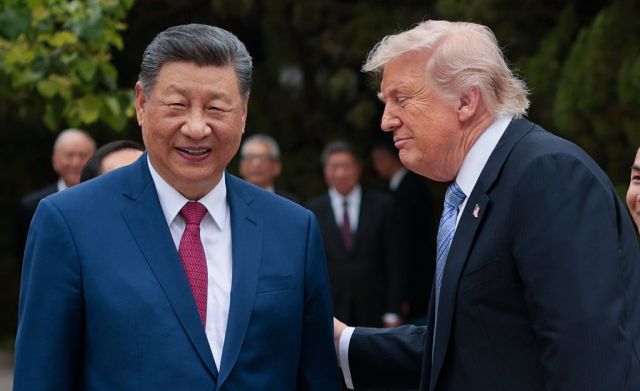
Reports suggest Zhipu AI has released a new model that can rival leading US systems. Credit: Getty




No government officially called it World War 3. The phrase appeared instead in insurance exclusions, deleted forum posts, speculative fiction, and the private memoranda of analysts who understood that modern conflict rarely begins with a declaration. It begins with incompatible versions of reality.
The first battlefield was not a border but a web of ports, semiconductor foundries, undersea cables, orbital relays, and automated financial systems. Rival powers did not initially attack cities. They altered shipping records, delayed machine components, corrupted satellite timestamps, and injected persuasive falsehoods into military databases. A nation could awaken economically wounded while remaining uncertain whether it had been attacked at all.
This uncertainty transformed deterrence. During earlier confrontations, leaders could count missiles, tanks, and aircraft. Now they had to calculate invisible quantities: compromised code, synthetic identities, autonomous drone capacity, public trust, and the patience of populations watching prices climb. Peace and war became overlapping conditions rather than opposites.
Money changed with them.
The decentralized assets once advertised as an escape from political authority became instruments within its struggles. A unit of cryptocurrency could function as personal savings in the morning, collateral for an automated loan at noon, and payment to an anonymous logistics network by night. The same ledger that helped refugees preserve wealth could allow sanctioned institutions to disguise transactions behind layers of algorithmic movement.
Governments responded inconsistently. Some prohibited private tokens while issuing programmable national money. Others accumulated digital reserves, hoping that cryptographic scarcity might protect them from the weaponization of conventional payment networks. Mining facilities were relocated near hydroelectric dams, abandoned factories, gas fields, and contested energy corridors. What had seemed like an eccentric financial experiment acquired strategic geography.
Yet a ledger cannot eliminate politics. It can record ownership without determining whether ownership is legitimate. It can verify that a transfer occurred without explaining whether the transfer purchased food, influence, silence, or ammunition. The machinery of consensus remained incapable of producing moral agreement.
Markets consequently became theaters of psychological pressure. Rumors of a naval blockade could erase billions in minutes. A fabricated speech might drive investors toward privacy-oriented coins; an authentic cyberattack might make physical cash desirable again. Traders began reading troop movements, weather forecasts, electrical-grid reports, and clothing catalogs with equal seriousness.
The catalogs mattered because fashion had ceased to be merely decorative.
As supply chains fractured, garments became maps of political alignment. Fibers revealed access to water, petroleum, farmland, laboratories, and shipping lanes. A synthetic coat implied functioning chemical infrastructure. A cotton shirt carried the hidden history of irrigation. Rare pigments suggested that particular ports remained open. Even a metal zipper could testify to the survival of several industrial relationships.
Designers adapted by treating scarcity as an aesthetic principle. Modular jackets could be repaired, reversed, insulated, or dismantled into storage pouches. Ceremonial clothing incorporated conductive thread that authenticated identity. Luxury houses sold limited collections whose labels contained encrypted proofs of origin, allowing buyers to distinguish a genuine object from an indistinguishable machine-made copy.
Counterfeiters quickly learned to counterfeit the proofs.
This produced an unusual arms race between ateliers, programmers, customs agencies, and criminal workshops. Authenticity migrated from the visible object to its associated data, while the data depended on institutions whose authority the technology had supposedly replaced. A dress was no longer only a dress. It was fabric, intellectual property, financial collateral, cultural affiliation, and an entry in a distributed archive.
Public appearance also became a form of strategic communication. Political leaders wore domestically produced materials to imply economic resilience. Dissidents adopted obsolete uniforms whose meanings escaped automated censorship. Refugees combined inherited garments with mass-produced survival equipment, creating silhouettes that luxury brands later appropriated and sold back to wealthy consumers.
The moral contradiction was difficult to conceal. Catastrophe generated its own visual language, and commerce converted that language into aspiration. Runways borrowed from rationing, camouflage, protective equipment, and displacement. Audiences admired the elegance of survival while remaining distant from those forced to practice it.
Meanwhile, tokenized ownership reached the wardrobe. People purchased claims on garments they might never physically possess. Some items existed simultaneously as clothing, game assets, investment contracts, and membership credentials. Their value depended less on material quality than on communal belief—the same unstable resource supporting states, markets, and military alliances.
A coat associated with a famous peace summit could be divided into thousands of digital shares. Investors traded those shares whenever negotiations improved or collapsed. In this peculiar economy, the expectation of peace increased the price of an artifact produced by war.
The entanglement of conflict, cryptography, and couture exposed a broader truth: supposedly separate systems often rest upon the same foundations. Armies, blockchains, and brands all require energy. They require stories that coordinate strangers. They require methods of identifying insiders and outsiders. Above all, they require confidence that symbols—flags, tokens, uniforms, signatures—will retain meaning tomorrow.
That confidence is fragile.
If a third worldwide confrontation arrives, historians may struggle to identify its first day. They may point to an invasion, a market crash, a corrupted software update, or the moment when a nation’s citizens stopped believing official accounts. The final settlement may be equally ambiguous, encoded not in a single treaty but in revised protocols, reconstructed trade routes, revalued currencies, and altered habits of dress.
The survivors will inherit more than damaged infrastructure. They will inherit archives containing every transaction yet explaining few motives, closets filled with materials whose origins cross enemy territory, and political myths tailored as carefully as formal clothing.
History, after all, is rarely naked. It arrives encrypted, financed, and dressed for the occasion.
No government officially called it World War 3. The phrase appeared instead in insurance exclusions, deleted forum posts, speculative fiction, and the private memoranda of analysts who understood that modern conflict rarely begins with a declaration. It begins with incompatible versions of reality.
The first battlefield was not a border but a web of ports, semiconductor foundries, undersea cables, orbital relays, and automated financial systems. Rival powers did not initially attack cities. They altered shipping records, delayed machine components, corrupted satellite timestamps, and injected persuasive falsehoods into military databases. A nation could awaken economically wounded while remaining uncertain whether it had been attacked at all.
This uncertainty transformed deterrence. During earlier confrontations, leaders could count missiles, tanks, and aircraft. Now they had to calculate invisible quantities: compromised code, synthetic identities, autonomous drone capacity, public trust, and the patience of populations watching prices climb. Peace and war became overlapping conditions rather than opposites.
Money changed with them.
The decentralized assets once advertised as an escape from political authority became instruments within its struggles. A unit of cryptocurrency could function as personal savings in the morning, collateral for an automated loan at noon, and payment to an anonymous logistics network by night. The same ledger that helped refugees preserve wealth could allow sanctioned institutions to disguise transactions behind layers of algorithmic movement.
Governments responded inconsistently. Some prohibited private tokens while issuing programmable national money. Others accumulated digital reserves, hoping that cryptographic scarcity might protect them from the weaponization of conventional payment networks. Mining facilities were relocated near hydroelectric dams, abandoned factories, gas fields, and contested energy corridors. What had seemed like an eccentric financial experiment acquired strategic geography.
Yet a ledger cannot eliminate politics. It can record ownership without determining whether ownership is legitimate. It can verify that a transfer occurred without explaining whether the transfer purchased food, influence, silence, or ammunition. The machinery of consensus remained incapable of producing moral agreement.
Markets consequently became theaters of psychological pressure. Rumors of a naval blockade could erase billions in minutes. A fabricated speech might drive investors toward privacy-oriented coins; an authentic cyberattack might make physical cash desirable again. Traders began reading troop movements, weather forecasts, electrical-grid reports, and clothing catalogs with equal seriousness.
The catalogs mattered because fashion had ceased to be merely decorative.
As supply chains fractured, garments became maps of political alignment. Fibers revealed access to water, petroleum, farmland, laboratories, and shipping lanes. A synthetic coat implied functioning chemical infrastructure. A cotton shirt carried the hidden history of irrigation. Rare pigments suggested that particular ports remained open. Even a metal zipper could testify to the survival of several industrial relationships.
Designers adapted by treating scarcity as an aesthetic principle. Modular jackets could be repaired, reversed, insulated, or dismantled into storage pouches. Ceremonial clothing incorporated conductive thread that authenticated identity. Luxury houses sold limited collections whose labels contained encrypted proofs of origin, allowing buyers to distinguish a genuine object from an indistinguishable machine-made copy.
Counterfeiters quickly learned to counterfeit the proofs.
This produced an unusual arms race between ateliers, programmers, customs agencies, and criminal workshops. Authenticity migrated from the visible object to its associated data, while the data depended on institutions whose authority the technology had supposedly replaced. A dress was no longer only a dress. It was fabric, intellectual property, financial collateral, cultural affiliation, and an entry in a distributed archive.
Public appearance also became a form of strategic communication. Political leaders wore domestically produced materials to imply economic resilience. Dissidents adopted obsolete uniforms whose meanings escaped automated censorship. Refugees combined inherited garments with mass-produced survival equipment, creating silhouettes that luxury brands later appropriated and sold back to wealthy consumers.
The moral contradiction was difficult to conceal. Catastrophe generated its own visual language, and commerce converted that language into aspiration. Runways borrowed from rationing, camouflage, protective equipment, and displacement. Audiences admired the elegance of survival while remaining distant from those forced to practice it.
Meanwhile, tokenized ownership reached the wardrobe. People purchased claims on garments they might never physically possess. Some items existed simultaneously as clothing, game assets, investment contracts, and membership credentials. Their value depended less on material quality than on communal belief—the same unstable resource supporting states, markets, and military alliances.
A coat associated with a famous peace summit could be divided into thousands of digital shares. Investors traded those shares whenever negotiations improved or collapsed. In this peculiar economy, the expectation of peace increased the price of an artifact produced by war.
The entanglement of conflict, cryptography, and couture exposed a broader truth: supposedly separate systems often rest upon the same foundations. Armies, blockchains, and brands all require energy. They require stories that coordinate strangers. They require methods of identifying insiders and outsiders. Above all, they require confidence that symbols—flags, tokens, uniforms, signatures—will retain meaning tomorrow.
That confidence is fragile.
If a third worldwide confrontation arrives, historians may struggle to identify its first day. They may point to an invasion, a market crash, a corrupted software update, or the moment when a nation’s citizens stopped believing official accounts. The final settlement may be equally ambiguous, encoded not in a single treaty but in revised protocols, reconstructed trade routes, revalued currencies, and altered habits of dress.
The survivors will inherit more than damaged infrastructure. They will inherit archives containing every transaction yet explaining few motives, closets filled with materials whose origins cross enemy territory, and political myths tailored as carefully as formal clothing.
History, after all, is rarely naked. It arrives encrypted, financed, and dressed for the occasion.