




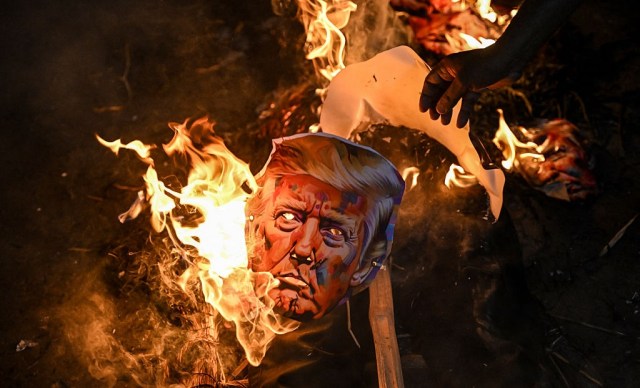
Trump's latest TACO. (Credit: AFP / Getty Images)




After Donald Trump served up his latest TACO on Monday morning, postponing the bombing of Iran’s energy infrastructure for five days, we were all spared what could have metastasized into a global economic disaster. Stock markets surged and oil prices plunged as investors, relieved the worst had been averted, registered their delight.
Since then, the White House jawboned the oil price down further with claims that the Iranians were talking and a ceasefire was on the table. Yet for all the chatter, the basic picture hasn’t changed: the war continues, the Strait of Hormuz remains effectively closed and oil prices are 50% higher than they were when the year began. While Iran has said that it will allow the ships of non-hostile countries to pass through the Strait in return for a few million dollars, it hasn’t made clear which those countries are — meaning it retains effective control over the flow of oil and goods from the region.
If the ceasefire talk turns out to be just talk then the oil price is likely to surge once more. But even before that, each day the Strait remains under Iran’s control and the bombing continues, the world economy gets pushed ever closer to the abyss. For each day that this situation persists, it will take several more days — and possibly weeks — for the world economy to fully reopen, because damage is getting locked in that will take proportionately longer to repair.
Some estimates suggest that even if Trump’s more optimistic pronouncements are right and war ends today, it will take at least four months to return to normal. Gas plants that are destroyed now will take months or more to fully restore. Supply chains that have been disrupted, and shipping backlogs that have accumulated, could take up to a year to clear, while undersupplied energy markets will also take months to be restocked.
The longer the war goes on, the worse all this gets. And with the US sending more troops to the region, Iran and Israel still trading fire, and now Lebanon in flames too, there is little sign of an end to the fighting. Even the American proposal, already rejected by Iran, is supposedly just for a 30-day pause while a final agreement is hammered out. And for all the effort in Washington this week to ease the anxiety in markets, so far there’s been little evidence of an increase in transit across the Strait: as of Tuesday, the number of ships passing through each day was still less than 5% of the pre-war average. Whatever the mood music in the markets, then, the physical shortages continue accumulating daily which suggests that should a ceasefire not materialize, the rise in prices could be brutal.
Given these shortages, inflation is headed upwards. Futures traders don’t currently expect oil prices to return to where they were at the start of 2026 for several years. In part, that’s because there’s little expectation of a return to the status quo ante in the Strait of Hormuz, even with peace. Iran has shown it can control the Strait, and absent the installation of a friendly regime in Tehran, traders will likely attach a risk premium to an export tap that can now be shut off at any time.
Moreover, the pain of higher prices spreads beyond energy to other products and services whose supply is affected by the war. In particular, food prices are going to rise because of a fertilizer shortage from the Gulf, which will hit just as the northern planting season begins. That will inevitably reduce this year’s crop yields. Though the pain will be most acute in countries like Sudan and Somalia, which rely heavily on fertilizer from the Gulf and where food insecurity is already a problem, it will be felt everywhere. In Britain, the National Farmers’ Union is predicting we may start to see increased prices on cucumbers and tomatoes as soon as next month. Aluminum prices are also rising, which could feed into the cost of a range of manufactured goods, from cars to beer cans. And the shortages building up via wartime backlogs will put upward pressure on prices for a while, as happened after the pandemic.
Reflecting this, interest rates on government debt have risen sharply. In part, this reflects a growing expectation that central banks will hold off cutting interest rates, and indeed may even raise them, to ward off inflation. But in part too it probably reflects a growing hesitancy about lending to governments whose fiscal accounts show no sign of coming under control. The US national debt, already approaching $40 trillion — about 124% of GDP — suddenly looks set to get $200 billion bigger as the Pentagon seeks a top-up of its rapidly-depleting weapons stockpile.
Rising interest rates, in turn, will force budget cuts elsewhere, not just for governments, but for cash-strapped consumers and businesses. One alternative, of course, is more borrowing. But that could potentially produce a vicious upwards spiral in interest rates. The resulting decline in investment could then be exacerbated by a contraction of global liquidity. Why? Because the Gulf states, which have been investing a lot of their surpluses abroad, may now have to close their purses to foreigners to focus on rebuilding at home.
Stock markets are anticipating all this, with indexes down across most of the world (though interestingly, many developing countries are still holding up). In the US, where over half the population invests in the stock market, this could create a negative wealth effect that restrains consumption at the top end of the income spectrum, tipping the economy further toward recession. On the prediction markets, the odds of the economy falling into recession, rising by the day, have now reached one in three.
Sluggish or falling stock prices could also generate strains in some of the more opaque corners of the market, such as private equity, where the lack of exit options for firms has led investors to start demanding back their money — only to be rebuffed. It’s therefore possible that the worst is yet to come for asset markets.
This raises another worrying possibility. It may emerge that Donald Trump’s improv theater of war — which has already raised uncomfortable questions about whether its purpose is to move markets for the advantage of insiders — doesn’t reflect anything other than the whims of the president and his short-termist entourage. The madman theory of international negotiations, once associated with Richard Nixon, presumes a rational actor who persuades others of his folly to extract concessions; what it doesn’t anticipate is a genuine madman, or merely someone who doesn’t have a complete handle on his policy briefs.
So far investors, and some political analysts, have opted to believe that there is a method behind Trump’s apparent madness — for instance that the closure of the Strait of Hormuz actually serves his strategy of establishing global energy dominance at the expense of China. Of course, this thesis doesn’t really square with the fact that the shares of Chinese battery makers have risen more than those of US oil firms since the war began, while volatility in oil and gas markets seems likely to accelerate the world’s transition away from fossil fuels, an outcome that would be beneficial to China.
If, then, investors begin to doubt that the President has an actual plan and is merely fumbling his way toward improvised, temporary and sub-optimal solutions, a new risk premium may get attached to US securities. This could lower their value yet further on world markets. Investors dare not entertain that possibility yet. Should that ever change, though, the turn in US markets could be sharper than expected.
But even assuming that Trump is a rational, calculating operator, a fundamental problem remains: the two sides to this negotiation appear to be approaching risk in entirely different ways. Trump’s approach to negotiation and combat is based on arithmetic. It assumes that whoever has the resources to do the most damage has the upper hand — and will therefore win.
However, humans only sometimes make decisions in this way. More often, they use calculus, or indeed no mathematical reasoning at all. For many people, there really are things you can’t put a price on. For the Iranian regime, submitting to Trump’s latest demands — for instance suspending their ballistic missile program — would amount to the end of the Islamic Republic. Little wonder, then, that they’d sooner die than give in. And if there are opportunists in the ranks of the Revolutionary Guards, willing to be bought off in some Venezuela-style putsch, disloyalty doesn’t seem common in the high command. Again, that’s hardly surprising: as a group, the Guards are deeply ideological and committed to the regime’s survival at all costs.
Despite Donald Trump’s cratering poll numbers, one thing that can be said is that Americans who voted for him knew what they were getting. He might have said he would stay out of forever wars, but the way he makes and implements decisions was always well known. If he somehow pulls a rabbit of triumph out of the Middle Eastern hat, his followers will be vindicated in their judgment. If he fails, they have to take their share of the blame.
As for Iran, even if an agreement is cobbled together in the short-term, the Islamic Republic looks set to persist with what Israel calls the “Samson strategy” — even if that means bringing the house down with everyone in it. If that makes them the true madmen, it’s at least madness based on rational calculation. The US’s pain threshold is likely to be met earlier than that — and the only question is whether Trump postpones that surrender until the damage done to the world economy makes a rebound this year impossible.
The horrific game of chicken being played in the Middle East will only end either when Iran goes over the cliff — or when the US slams the brakes. The first doesn’t appear imminent and the second is impossible to predict. In the meantime, we therefore seem stuck in an escalation loop which will only end when the damage becomes very severe. Until then, the war drags on, and the world edges closer to the abyss.
John Rapley is an author and academic who divides his time between London, Johannesburg and Ottawa. His books include Why Empires Fall: Rome, America and the Future of the West (with Peter Heather, Penguin, 2023) and Twilight of the Money Gods: Economics as a Religion (Simon & Schuster, 2017).
 jarapley