




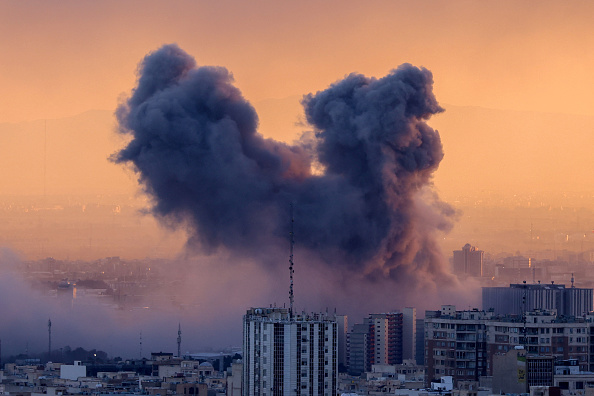
Regime change from above. (Credit: ATTA KENARE / AFP via Getty Images)




Until Trump’s Caracas raid — which swiftly converted Venezuela’s dictatorship from the Mr and Mrs Maduro drug cartel to a reasonably obedient American protectorate — it was a supposed axiom of US strategy that regimes cannot be changed without “boots on the ground”. In practice that meant, after the multi-trillion dollar failures in Afghanistan and Iraq failures, that the US could not change regimes at all: when the US Army, US Navy, US Marine Corps, and US Air Force arrive somewhere, and they all insist on participating, boots are nowhere near enough.
All manner of extravagant non-military missions — advancing political feminism in Afghanistan, among many others — are quickly added to already luxurious supply requirements and end up feeding well-connected contractors and their expensive lobbyists. Soon enough, the actual cost per bullet fired makes it too expensive to kill enough uncooperative locals to accomplish the mission.
Trump’s Iran war is most definitely of the boot-less variety — and the shoes of the covert operative in Tehran and elsewhere are all on Israeli feet. This neatly eliminates the built-in failure mechanisms of past US interventions. Aside from “nation-building” fantasies bound to fail, troops on the ground mean casualties, which raise the political price of calling off an expedition with its goals visibly unachieved. Thus losing interventions persist: for almost 20 years in Afghanistan, which was supposed to last the 90 days needed to find and kill Bin Laden’s band, and over eight in Iraq, even though Saddam’s regime was brought down in less than a month.
But to go from non-failure to success, two things must be done. The most urgent, even if it is not actually the most difficult, is to demolish Iran’s capacity to launch the ballistic missiles and the explosive drones that have so far landed from the Gulf to Israel to Cyprus, killing some civilians and wounding more.
Because only a small fraction of the missiles produced by the Revolutionary Guards — whose quality controls are not up to Toyota standards — actually do enter boost phase, do reach their apogee, and then do descend correctly with enough precision to hit somewhere in the right country and not fall into the sea, they too have a cost-effectiveness problem just as US shooters did in Afghanistan. In fact, the total cost to Iran per Israeli or Arab killed or wounded is extravagantly high, and that of course means that the cost of preventing those very few casualties with missile defenses is just as extravagant.
Even so, the US and Israel cannot just sit back and do nothing merely because Iran’s missiles and drones are not cost-effective. Every day and every night, therefore, US and Israeli fighter-bombers must fly out to the missile storage and launcher sites scattered across western Iran to detect and destroy missiles on their just-erected launchers, even as others drop steel-jacketed 2,000-pound penetrator bombs where they detect underground storage sites. Now that Saudi Arabia, the UAE, Kuwait and Qatar are all asking for anti-missile interceptors, and there is a danger of exhausting the supply, heavy bombers are also attacking Iran’s missile-storage sites whenever they are detected.
Another unavoidable military, or rather naval task, is to ensure the safe passage of oil and LNG tankers from Persian Gulf ports into the Indian Ocean and beyond through the Straits of Hormuz, which are only 21 miles wide in their narrowest parts. As it is, the tankers carrying Gulf LNG to the world are the objects of recurrent Iranian threats to “close the straits”. Iran cannot do this with a lock and key, nor does it have to: it would be enough to visibly damage a couple of tankers headed for the Straits to discourage the rest from even trying. Iran is not one of the world’s great naval powers, but in October 2023 it had both the 14 frigates and three submarines of the regular Artesh navy, and the corvettes and fast-attack missile boats of the Revolutionary Guards, with which to hit a tanker or two.
It follows that every one of those vessels had to be destroyed pre-emptively, not a difficult task even for the unassisted Israeli airforce, let alone for the US Air Force and Navy, which now has two aircraft-carrier task forces within striking range of all parts of Iran.
The much greater challenge in trying to replicate the Venezuela model of intervention, one that stops live threats and sets a dictatorship on a better path, with no US troops and no occupation, is to recruit and empower a less-than-horrific regime figure: one who has enough authority to steer the government in the right direction.
That is how Delcy Rodríguez, who was Maduro’s notably hardline and seemingly ultra-faithful vice president, but who eagerly accepted the job, was chosen as the interim ruler of Venezuela. With the help of her brother, Jorge Jesús Rodríguez Gómez, who usefully presides over an obedient national assembly, she has performed tolerably well, expelling Iran’s agents from Caracas (Maduro’s narco partners were the first to flee), liberating political prisoners, and stopping the flow of free oil to Cuba.
Delcy Rodríguez was not recruited to serve as the interim viceroy because she was any more liberal or pro-American than Maduro — or more opposed than him to drug-dealing — but because she was able and willing to overcome resistance to the drastic changes the US is demanding and which are visibly underway.
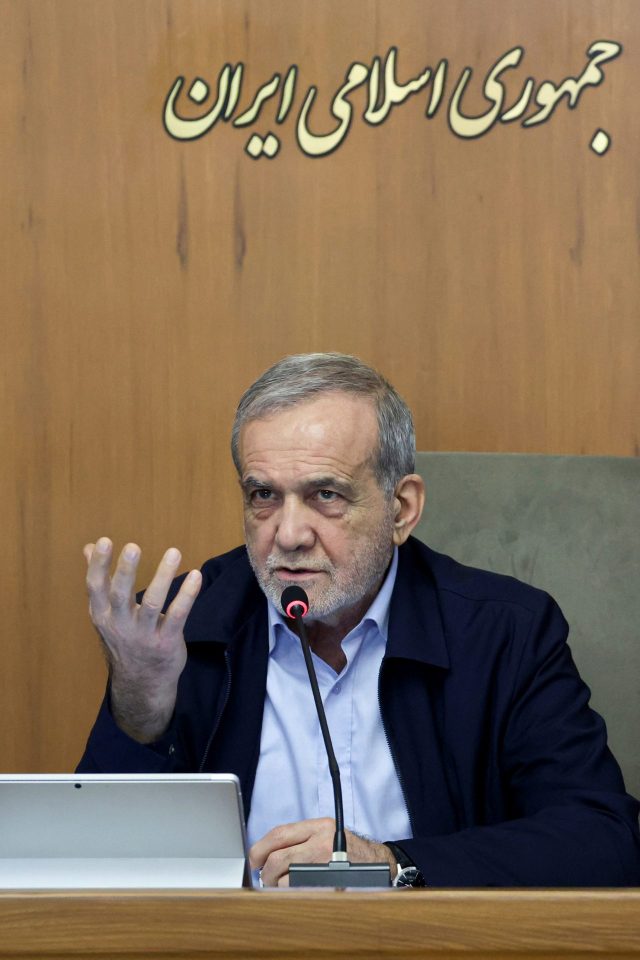
Iran’s best candidate to lead the country on a path to democracy — once the war has thoroughly demoralized and dispersed the Revolutionary Guards, and sent the low-paid Basij militia in search of better employment — has every possible virtue but one. For one thing, Masoud Pezeshkian personally represents multi-ethnic Iran very well. He is an ethnic Azeri brought up in Iran’s most significant Kurdish-speaking town, while also being immersed in secular Persian culture more vigorous than ever after the Ayatollahs tried to kill it. Even better, Pezeshkian is that great rarity in the Muslim world: a president who was actually elected.
After the sitting President Ebrahim Raisi, a former prosecutor who had imposed thousands of death penalties, was killed in a helicopter crash in May 2024, Saeed Jalili, an equally extremist replacement, offered his candidacy. But at that point, Iran was the scene of increasing anti-hijab protests, while the economy had started to sink under the weight of foreign sanctions.
Ayatollah Khamenei therefore decided to allow Pezeshkian’s candidacy. A technocrat rather than a fanatic, it was hoped that Pezeshkian would encourage Iranians to vote instead of abstaining, offering evidence that the Islamic Republic enjoyed a measure of popular acceptance. With a veteran nuclear negotiator alongside him, Pezeshkian obtained many more votes than Jalili and became president on 6 July, 2024, amid great hopes that there would soon be a new nuclear agreement, that Iran’s economy would be rescued by rising oil exports, and that it might even enjoy some foreign investment.
Those hopes were crushed when Khamenei withdrew his support from any real nuclear negotiations, and refused to divert the country’s foreign-exchange earnings from the Revolutionary Guard towards rebuilding Iran’s horribly neglected water and energy infrastructures; unlimited gas is of no use without pipelines.
Pezeshkian tried his best, most notably by loudly warning that Tehran’s entire population, which exceeds 10 million, might have to be evacuated because of a sheer lack of water — unless a vast emergency program was started immediately. But even that did not stop the continued diversion of most of Iran’s hard-currency earnings to hugely overbuilt nuclear projects, and to produce more and more ballistic missiles and support expensive foreign militias. In other words, Pezeshkian was powerless.
But since then, the Revolutionary Guards have been decapitated by US and Israeli ultra-precision bombing; many of their officers have died alongside the Arab militias they armed, trained and led to utter defeat; and more have been killed by the systematic bombing of their distinctive headquarters in Tehran and other cities. All their grand plans have very visibly failed, there is no more money for the Basij — and there is no credible replacement for the fanatically extreme but very experienced and wily Khamenei. Yes, the regime quickly chose his son Mojtaba Khamenei, but Iran’s theocracy must be headed by a supremely expert religious scholar (faqih), which cannot just be named as such by the Revolutionary Guards: he must be recognized by the top Shi’a academies in both the Iranian city of Qom and Najaf in Iraq. Mojtaba utterly lacks those credentials, and the scholars cannot possibly accept him as his father’s replacement.
All that leaves Pezeshkian, who is alive and well, as the last man standing. Assuming that he has enough Azeri and other followers to protect him, he could be Iran’s bigger and better answer to Delcy Rodríguez.
Professor Edward Luttwak is a strategist and historian known for his works on grand strategy, geoeconomics, military history, and international relations.
 ELuttwak