




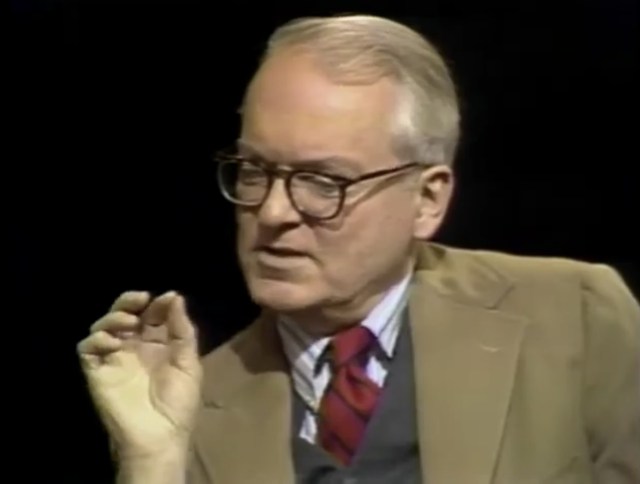
John Murray Cuddihy on Firing Line, 1974. (Credit: YouTube)


People on the internet like to be mean to venture capitalist Marc Andreessen. At least the poor man doesn’t dwell on it. Last week, on the Founders podcast with David Senra, Andreessen boasted about his “zero-introspection mindset”. He cast himself as akin to the great men of yore: “if you go back 400 years, it would never have occurred to anybody to be introspective.” Marcus Aurelius? St Augustine? Napoleon? Hamlet? Another round of online mockery came thick and fast.
Amid the noise, one question remains unanswered: where did Andreessen pick up this strange idea? He gives some hints in his ensuing “crash-out”. Defending the claim that “great men and women of the past were not sitting around moaning about their feelings”, he encouraged his 2.3 million followers on X to “read your Adler, Cuddihy, and Nietzsche, ffs”. He elaborated on the second of these in a follow-up tweet, this time with the assistance of “my sociology professor Claude”.
John Murray Cuddihy, we learn in typical AI speak, provided “one of the most corrosive critiques of therapeutic culture ever written – and it’s corrosive precisely because it doesn’t attack therapy on its own terms. It attacks the genealogy. It asks: where did this whole enterprise come from, and whose interests does it serve?” Alas, Andreessen and Prof. Claude fall short of answering their own question. “Here is the brutal Cuddihy take, assembled fully”, the tweet concludes: “[Details removed to protect the reader.]”
Who was John Murray Cuddihy? Whose interests did he think “introspection” served? What made his ideas so “brutal”, so “corrosive” — so subversive, even, that they apparently risk upsetting or scandalising the faint of heart?
John Murray Cuddihy, an American sociologist who died in 2011, is hardly a household name. His book The Ordeal of Civility (1974) would set you back £294 on Amazon; there is not even a single copy of No Offense: Civil Religion and Protestant Taste (1978) to be found in the exhaustive collection of Oxford’s Bodleian Library. But Cuddihy has always enjoyed a small cult following. When The Ordeal of Civility was published, James Burnham described it as “one of those few books likely to change history” and Cuddihy was invited to promote it on William F. Buckley’s talk show, Firing Line.
Half a century later, his star has at last begun to rise again. Anna Khachiyan, of the Red Scare podcast, is probably his most prominent cheerleader. Just the day before l’affaire Andreessen commenced, the notorious Right-wing troll Captive Dreamer — whose 80,000 followers on X include Vice President JD Vance — was dipping into the Cuddihy œuvre. “Have you taken the Cuddihypill?”, asks fellow chud, Bronze Age Pervert. Let us take the Cuddihypill, now, and see the Matrix for ourselves.
In The Ordeal of Civility: Freud, Marx, Lévi-Strauss, and the Jewish Struggle with Modernity — to use its full subtitle — Cuddihy traced the ideas of his triad of Jewish thinkers to a “Kulturkampf” which accompanied the emancipation of the Jews in the 19th century. As the Jews emerged from their cramped, smelly shtetls and ghettos, they had to adjust to a “Protestant Etiquette”. They couldn’t cope, says Cuddihy; they couldn’t abide by the code of bourgeois life. They relapsed into their old tribalism, their inwardness, their vulgar “Yiddishkeit“. They were deviant. And then — here one can see why Cuddihy’s ideas have a reputation for being transgressive, even offensive — they concocted elaborate theories to explain away their deviance, usually as some kind of “symptomatic behaviour”. For Marx it was a symptom of economic exploitation; for Freud a symptom of psychosexual regression. The ideas of Marx and of Freud were Jewish ideas, according to Cuddihy, because they originated in a specifically Jewish experience — a specifically Jewish “ordeal”.
The Ordeal of Civility is principally a book about Freud. 100 pages are devoted to Freud — three times as many as are spent on Marx and ten times the paltry section on Lévi-Strauss. The book is in effect an answer to a famous question Freud once put to his friend Oskar Pfister, a Swiss pastor: “Why did none of the devout create psychoanalysis? Why did one have to wait for a completely godless Jew?” Cuddihy’s answer is that Freudian psychoanalysis was, from the start, an attempt to “make sense of the Jewish emancipation experience”. He came up with a Dr Seuss-style ditty to summarise his argument: “the id of the ‘Yid’ is hid under the lid of Western decorum”. The struggle between the id and the superego reflected, in miniature, the struggle between Yiddishkeit and the strictures of bourgeois respectability.
So, if we are to steelman Andreessen’s argument, Freudian “psychologism” — the set of ideas that the venture capitalist was attacking as introspection — served a particular set of interests. By uncovering the id lurking within the minds of all men, Cuddihy argued, Freud engineered a “moral equaliser legitimating social equality between Jew and Gentile”.
It’s an eccentric argument, to say the least, and it is natural to wonder about Cuddihy’s motivations in devising it. Certainly, it appears at first glance to carry strong antisemitic implications. His work is peppered with overfamiliar Yiddishisms: kvetsches, tsuris, and an awful lot of goyim. An uncharitable reader might find something sinister here; but one might instead interpret this as a sign of Cuddihy’s personal identification with the Jewish community, bordering even on what one reviewer called a “remarkable affection for and indulgence in old Jewish culture”. Cuddihy was a lapsed Catholic of Irish heritage and he shared with the Jews a feeling of alienation from the WASP “core culture” which still prevailed in America. He, like the Jewish thinkers surveyed in his book, struggled to socialise himself into modernity — because modernity was a creation of “Calvinist Christianity”, from which he and the Jews were perennial outsiders.
It is often difficult to discern what exactly Cuddihy was aiming for. His essay of 1987, “The Elephant and the Angels: The Incivil Irritatingness of Jewish Theodicy”, doesn’t explain why Jewish arguments about the nature and origins of antisemitism are wrong — only why they are liable to strike non-Jews as “irritating and incivil”. Rabbi Yitz Greenberg caught on to the slippery, double-edged nature of Cuddihy’s arguments. Was he telling the Jews that they were “incivil” and “irritating” as a piece of friendly advice from a well-intentioned outsider — or as a petty jab at a people for whom he felt genuine disdain? When, in No Offense, he reflected on Jewish “chosenness”, was he arguing for the Jews to hold true to their ancestral beliefs, including those which the “Protestant Etiquette” found chauvinistic or ill-mannered — or was he warning the rest of the world that the Jews really do believe in their own superiority?
Many of Cuddihy’s Jewish critics were quick to assume the latter. “Cuddihy aims to be revolutionary”, begins one review of The Ordeal of Civility; “he may merely be revolting”. Still, it would be wrong to think that his arguments have only ever appealed to antisemites. There can’t be many intellectuals who have been cited approvingly both by the antisemitic conspiracy theorist Kevin Macdonald and by the late Chief Rabbi Lord Sacks.
Nor can Cuddihy’s arguments be dismissed outright. A celebrated passage in The Ordeal of Civility concerns the “tale of two Hoffmans”: Abbie Hoffman, the ringleader of the anti-establishment “yippie” group the Chicago Seven; and the judge Julius Hoffman, who sentenced him. (The drama plays out in Aaron Sorkin’s movie The Trial of the Chicago 7, with the Hoffmans played by Sacha Baron Cohen and Frank Langella respectively). This, in Cuddihy’s hands, becomes an “intra-Jewish fight” acting out an “ancient scenario: the socially unassimilated Eastern European Jew versus the assimilated German Jew who ‘passes’ among the goyim”.
Each Hoffman was ashamed of the other. Julius was ashamed of Abbie for misbehaving, Abbie of Julius for behaving. It may seem a bit far-fetched to view this exchange purely through the Jewish prism; clearly there were other things at stake. And yet, “of all the material I’ve read dissecting the trial”, Abbie Hoffman confided in his memoir, “none captures my own attitude better” than Cuddihy’s. Another socialist Jew of the Sixties, Mark Rudd, also thought that Cuddihy had hit on something profound. Cuddihy was fascinated by “the curious, secret, adversary relationship of the secular Jewish intellectual to the Jewish bourgeoisie”, according to which “the intellectual is sensitive and refined; the bourgeoisie, obviously, is vulgar”. Why, I now think to myself, I am a sensitive and refined Jewish intellectual — and I feel nothing but love for the Talis and Yonis of Edgware, with their IDF jumpers and flashy Magen David necklaces!
So sometimes, it must be conceded, Cuddihy was on the money. He understood the peculiar neuroses of the Jewish diaspora better than many Jews understand themselves. But that is not the reason The Ordeal of Civility is enjoying its modest resurgence. Andreessen holds it up as a source of secret knowledge, and gets a kick out of the idea that it’s blasphemous and controversial. He thinks it offers a convincing theory about the origin of this pernicious idea of introspection. He thinks, in his own words (or Claude’s), that “therapeutic culture” serves some Jewish interest, and that Cuddihy demonstrated this by reference to Freud. This argument is plainly wrong. Cuddihy’s analysis doesn’t even work as an interpretation of Freud. How can it work as an interpretation of the entire phenomenon of Jewish intellectualism? The argument falters on a single point: Freud did not emerge from the shtetl. His “id” had nothing at all to do with the “Yid”: not even the rhyme works in the original German. Freud’s thought was not the product of a clash between the Jewish “Middle Ages” and bourgeois modernity. His father was Germanised, much as Marx’s had been. Unlike Abbie Hoffman, he felt no real compunctions about that fact. Nor was there any wrenching “struggle” with modernity. Freud was in Vienna by the time he was a toddler.
Cuddihy’s mode of analysis is a kind of ham-fisted determinism. Any thought which has ever been had by a Jew is by nature a Jewish thought, produced solely by its thinker’s Jewishness. The Jewish dog, in Cuddihy’s telling, salivates at some suitably self-serving Jewish ideology whenever the bell of modernity is rung.
Such an approach is astonishingly unscientific, but it is unscientific less in the manner of conspiratorial antisemitism, than in a manner unfortunately characteristic of “social science”, which reduces all human ingenuity to the products of hazily-defined “environmental factors”. “To make any kind of sense”, Cuddihy warns his readers at the outset, The Ordeal of Civility “should be placed in the context of my interests and convictions, and a certain indulgence will be asked, allowing me simply to assert these convictions and interests, rather than to argue them”. Well, this will not do. One of Cuddihy’s affected Yiddishisms springs immediately to mind: this is a work of chutzpah. Cuddihy’s critics held him to be an antisemite, and his latter-day admirers, Andreessen among them, have squeezed a certain frisson out of that fact — all the more in a moment when antisemitism is gaining ground. I do not think that Cuddihy was an antisemite. But he was something worse: a sociologist.

Join the discussion
Join like minded readers that support our journalism by becoming a paid subscriber
To join the discussion in the comments, become a paid subscriber.
Join like minded readers that support our journalism, read unlimited articles and enjoy other subscriber-only benefits.
Subscribe