


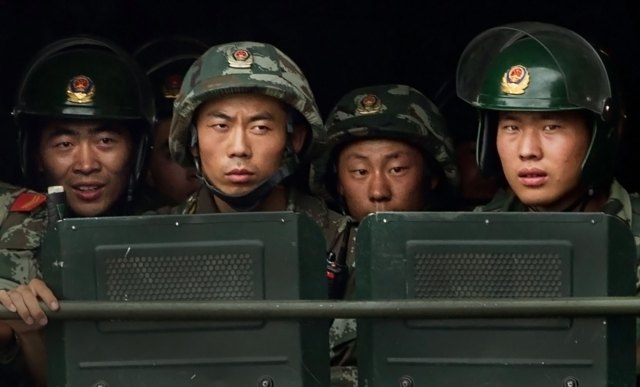
Taiwan is under siege (Getty Images)




The government in Beijing likes to portray its attitude towards Taiwan as the final resolution of its anti-colonial struggle; the end of its self-described “century of humiliation” at the hands of foreign powers. But the opposite is true. Today, as the People’s Republic of China continues its naval live fire exercises just off the island’s main ports and airports, it is Taiwan that is under siege.
Think of Taiwan as China’s Ireland. Even the timelines are similar. In the late seventeenth century, just a couple of decades after Oliver Cromwell brutally suppressed the Irish Catholic Confederation, the Qing Empire invaded Taiwan, bringing part of it under colonial rule for the first time. Even after its partial annexation in 1684, the Qing treated the island as a dangerous frontier, notable mainly for its wild “aborigines” and deadly diseases.
Some parts of the island were never conquered; upland areas with difficult terrain were left alone, so long as they did not interrupt the peace of the lowlands. The Qing regarded these areas in much the same way as British India regarded its Northwest Frontier: places of savagery in need of management and occasional punitive expeditions.
Taiwan only formally became a distinct province of the Qing Empire in 1887, two years after the end of a war with France, in which control of the island’s ports had become strategically important. The new provincial administration made a display of bringing the benefits of civilisation from the mainland: railways, medicines and taxes. Local reactions were mixed.
The island remained under Qing control for just eight years before it was snatched by Japan at the humiliating end of the 1894-95 Sino-Japanese War. The treaty signed in the port city of Shimonoseki granted Japan control of Taiwan “in perpetuity and full sovereignty”. Taiwan became a colony again, this time to a different master. There was some resistance on the island, but it was rapidly snuffed out. Another set of railways, medicines and taxes were introduced.
Within a few years, people on the Chinese mainland forgot the cause of Taiwan. There was no agitation to “restore” the country to mainland control. Even the nationalist revolutionary Sun Yat-sen ignored its plight. He used the island as a revolutionary base during his campaign to overthrow the Qing Empire, but did nothing to try to foment anti-Japanese activity there. For the Nationalists, Taiwan had been lost and that was that.
This loss was then written into the country’s new constitution after the Nationalist Revolution of 1911-12. Article 3 stated simply: “The territory of the Chinese Republic consists of 22 provinces, Inner and Outer Mongolia, and Tibet.” The choice of “22” provinces explicitly excluded the former province of Taiwan. This vision of China’s territory, one limited to the mainland, was printed on all the country’s maps throughout the Twenties and Thirties. Taiwan was not part of the country.
This view was also shared by the Communist movement. At its sixth congress in 1928, the Communist Party recognised the “Taiwanese” as a separate nationality. In November 1938 the party plenum resolved to “build an anti-Japanese united front between the Chinese and the Korean, Taiwanese and other peoples”, implicitly drawing a distinction between Taiwanese and Chinese. Both Nationalists and Communists regarded the “Taiwanese” as a distinct minzu — which can mean both “nation” and “ethic group”.
It was only in the middle of the Second World War, once it looked like Japan was going to lose, that the rival Chinese leaderships “rediscovered” Taiwan. From mid-1942 onwards, the Nationalist Party (the Kuomintang) under Chiang Kai-shek went to great lengths to redefine Taiwan as truly Chinese and to stretch the “national geobody” to include the island. This was, in large part, motivated by the idea that Taiwan was vital to the defence of the country.
A few months after Japan’s surrender, a nervous group of Chinese officials arrived on the island and began to set up a new administration. But there were many in Taiwan who had no wish to be incorporated into the Republic of China. Some had benefited from the Japanese occupation, some objected to the corruption of the Chinese government, while others were simply hostile towards incomers from the mainland. Protests finally exploded on 28 February 1947 and were met with extreme violence. By the end of March, at least 5,000 Taiwanese (some say 20,000) had been killed by the mainland forces.
These colonial attitudes towards Taiwan are clearly displayed in Chiang Kai-shek’s 1947 book China’s Destiny. There, he writes that “Formosa [meaning Taiwan], the Pescadores [the islands just west of Taiwan], the Four Northeastern Provinces [Manchuria], Inner and Outer Mongolia, Sinkiang [Xinjiang], and Tibet are each a fortress (or strategic area) essential for the nation’s defense and security.” For Chiang, these outlying areas must be attached to China purely to protect the core areas of the ‘motherland’ from foreign attack.
Ironically for Chiang, Taiwan became a shield that protected him not from foreign attack but from communist control of the motherland. In 1949, at the end of the Chinese Civil War, the Guomindang government fled to the island. Initially this was only intended to be a temporary redoubt, a place to regroup before the recapture of the mainland. The Guomindang continued to present itself to the world as the legitimate government of the Republic of China and occupied China’s seat at the United Nations until 1971.
This fiction obscured the basic fact that Taiwan had only been ruled as part of the mainland for four years, from October 1945 to late 1949. But during this time the Guomindang brought, in effect, yet another colonial administration to the island. The party acted as if it were a Chinese government ruling the entire country including the mainland. With the force of military dictatorship, it imposed Mandarin over the local languages of Hokkien and Hakka and those spoken by the upland peoples. They imposed mainland norms under the banner of Chinese nationalism and attempted to impose a homogenous ‘Chinese’ identity.
The legacy of these impositions, and the resistance towards them, still divides politics in Taiwan today. The ranks of the Guomindang are still largely filled by the descendants of those who came to the island with Chiang Kai-shek. The current ruling party, the Democratic Progressive Party, represents that part of the population that resists the idea of mainland control. The family of Taiwan’s current president, Tsai Ing-wen, is of Hakka origin, for example. Just like Ireland today, the country’s politics divide over relations with “the mainland”. Even the use of that term raises hackles in Taiwan, just as it can in Ireland.
Over the 77 years since Taiwan was reincorporated into the Republic of China, the political and demographic situation has changed radically. Only a very few diehards believe the “Republic of China” will ever recapture the mainland and “reunite” the motherland under non-communist control. The island is a de facto independent state, albeit one that is not formally recognised as such by any other country. If you visit the British “Representative Office” in Taipei, you’ll discover that it has exactly the same crockery as every British embassy around the world, except that the royal coat of arms is missing from the plates. The UK, just like everyone else, treats Taiwan as an independent government, but doesn’t want to advertise the fact.
Taiwan’s non-existence has not prevented its businesses from exporting or its people from enjoying a standard of living equivalent to that in the United States, one that is vastly higher than China’s. Its passports (issued in the name of the “Republic of China” in Chinese but ‘Taiwan” in English) grant visa-free access to 145 countries, almost double China’s number. But turning this de facto independence into constitutional reality would, in the eyes of Beijing, be grounds for war.
Most Taiwanese — let’s call them that — enjoy the status quo across the Taiwan Strait. The PRC is Taiwan’s biggest trading partner, many Taiwanese are related to families living on the other side of the water, and in normal times the island benefits from the relatively free flow of people and trade across it. Aside from a few fantasists, no-one in Taiwan wants a war with the PRC, but nor do they want to be “reunified” with an authoritarian state that appears to be on a political journey from “socialism with Chinese characteristics” to “national-socialism with Chinese characteristics”.
Xi Jinping learnt his history from the simplistic nationalistic books of his youth: just like Chiang Kai-shek, he is a colonialist. As the people of Tibet and Xinjiang can testify, he has a “steamroller” view of national unity. He orders homogeneity in the name of the “great rejuvenation of the Chinese nation”. He will not rest until he has ‘restored’ every rock and reef in the South China Sea and barren Himalayan mountainside to the motherland. Taiwan would be the jewel in his proletarian crown.
Bill Hayton is an associate fellow with the Asia-Pacific Programme at Chatham House. He is the author of The Invention of China, published this month by Yale University Press
 bill_hayton