




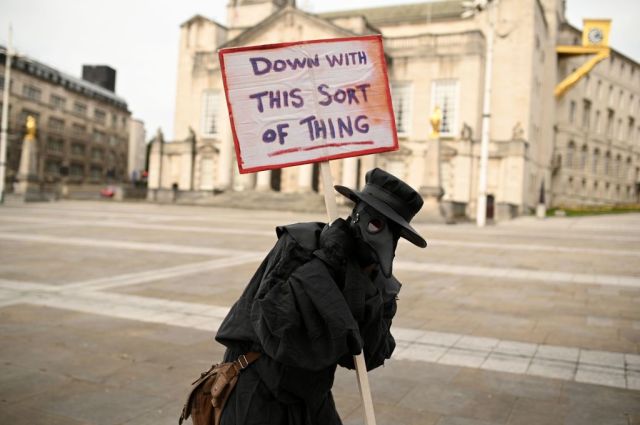
You have to laugh. Credit: OLI SCARFF/AFP via Getty Images


A year from now you will all be laughing at this virus. Well not all of you, obviously.
Too soon?
First rule of comedy: it’s never funny unless it risks something, unless there exists the possibility of disapproval, of offence. And the greater the possibility of offence, the funnier it is. To be clear: it’s not the offence itself that makes something funny. Many would-be ‘brave’ comedians make this mistake. But the presence of the possibility of causing offence is certainly a multiplier when something is funny. The greater the repression, the more explosive the release.
We laugh in the presence of Covid-19 death charts because, well, what else can we do? The darkness of the present situation is not an argument against the possibility of laughter, but exactly why it is so necessary. We laugh to transform what we fear into something that cannot psychologically overwhelm us. It is a strategy of resistance.
You may remember from Harry Potter that a boggart is a shape-shifting creature that assumes the form of the worst fears of the person who encounters it. The spell that banishes a boggart is the riddikulus spell, which converts the terrifying apparition into something that can be laughed at. And once laughed at, all power is drained from the boggart and it disappears. A scary teacher is dressed up in the clothes of a fusty old woman, a giant spider is given roller-skates and cannot stand up. What would be the point of using the riddikulus spell on something that isn’t terrifying? In other words, comedy was designed for things like Covid-19.
This is why it makes no sense to say that some things are too serious to be joked about. On the contrary, only serious things can properly be joked about. And if it’s not serious, it’s not funny.
The funniest people I know, as a profession — apart from professional comedians — are undertakers, closely followed by nurses and those who work in the emergency services. Surrounded every day by pain and death, humour becomes a way of asserting that most specifically human of all reactions to the tragedy of life: laughter. On the one hand it creates a kind of solidarity in the face of fear and danger. But it also puts the danger in its place.
In this regard it’s hard to beat Spike Milligan’s famous epitaph, written on his gravestone: “I told you I was ill”. If I am right about the purpose of humour, this is about as perfect a joke as one could imagine. For to carve a joke on your own gravestone is to poke fun at our greatest fear within its own castle, and to do so in such a way that the darkness can never have the last laugh. You can just imagine Milligan’s words driving the grim reaper mad with frustration and fury. To have someone take the piss out of him rather than quake in terror is the ultimate riddikulus spell.
Freud put it rather more seriously in his 1927 essay On Humour:
“The ego refuses to be distressed by the provocations of reality, to let itself be compelled to suffer. It insists that it cannot be affected by the traumas of the external world; it shows, in fact, that such traumas are no more than occasions for it to gain pleasure.”
Something similar is going on with Ricky Gervais’s comedy series After Life — season two of which has just been released on Netflix. Gervais’s character, Tony, is depressed and nihilistic, his wife having just died of cancer. He says things like: “A good day is when I don’t go around wanting to shoot random strangers in the face and then turn the gun on myself?”
It’s not a laugh a minute show. Sometimes you even question if it’s really a comedy at all. But because it’s Gervais, and perhaps because we know there will be moments of great humour — there really are — we allow him to take us into some pretty bleak situations. “That’s what humour is for,” Gervais told Holly Willoughby on the This Morning show last Monday, “to get us through bad stuff.”
Perhaps Gervais won’t like this way of putting it — given he’s such a passionate atheist — but this sort of comedy feels like it has a fundamentally redemptive purpose. It allows us to exist within the darkest of situations without being overwhelmed by them. To misquote Nietzsche: “We have comedy so we don’t perish of the truth”. Humour is a readily available coping mechanism. It’s a strategy of resilience.
But there is a potential fly in the ointment of this argument. My wife — who is from Israel — is of the opinion that the humour I am talking about here is very specifically British humour. They wouldn’t get Covid-19 humour in Tel Aviv, she explains.
Now while I don’t altogether believe this, the argument still slightly bothers me because if I’m right about the fundamental connection between death and comedy, surely it would be a universally identifiable phenomenon.
Or maybe it’s just that the sort of comedy I am talking about is particularly acute in cultures with high degrees of emotional repression. And given that sex, death and status are hang-ups that us Brits have in considerable measure, perhaps there is something to this. Freud understood humour as a kind of release, a way for pent up, forbidden thoughts to come tumbling out. That’s why there is no such thing as ‘safe’ humour. Humour is no respecter of either political or emotional repression.
That’s why those people who think that coronavirus humour is just “a little too much” won’t ever understand those of us who find something funny not just in spite of it being a little bit inappropriate but precisely because it is. Safe, appropriate humour is never terribly funny. Which is kind of the point.

Join the discussion
Join like minded readers that support our journalism by becoming a paid subscriber
To join the discussion in the comments, become a paid subscriber.
Join like minded readers that support our journalism, read unlimited articles and enjoy other subscriber-only benefits.
Subscribe